What Is Montessori Education?
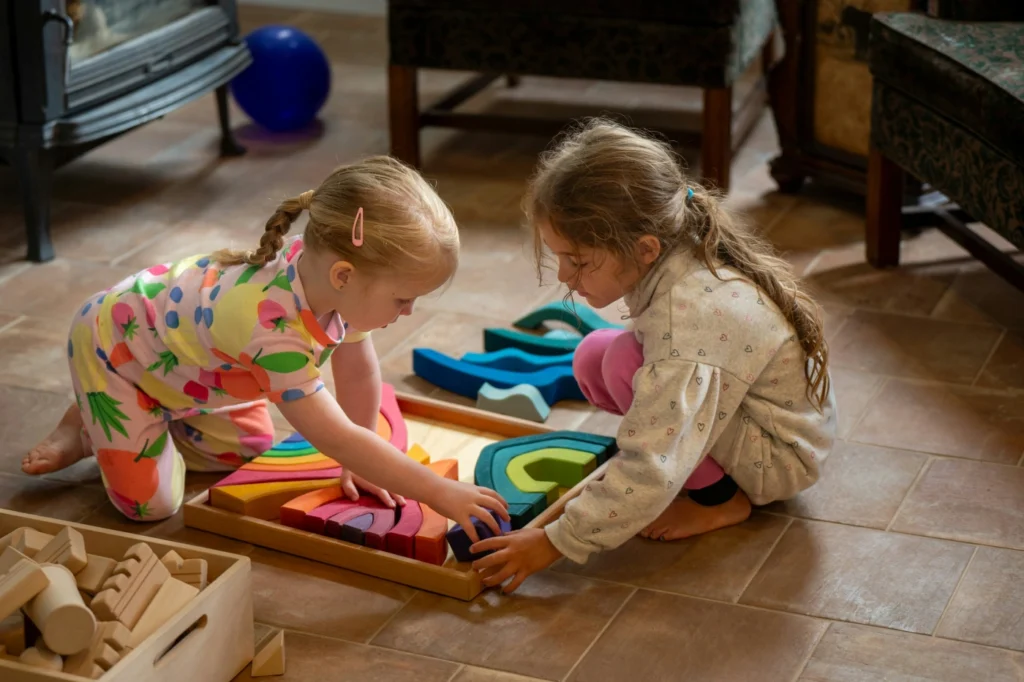
Montessori is an approach to early education built on the idea that children learn best when they are free to explore, guided by a trained adult in a carefully prepared classroom. Children choose their work from child-sized shelves of hands-on materials, spend long, uninterrupted periods on it and move on when they are ready. The teacher observes, shows how to use materials and steps back.
What Is a Traditional School?
In a traditional classroom, the teacher plans the lessons and teaches the whole class together, usually from the front. Children of the same age follow the same syllabus at the same pace, mostly through books, worksheets and teacher explanation, and progress is checked through tests and exams.
This approach gives clear structure, a shared curriculum and a familiar way to prepare for later board exams.
Montessori vs Traditional School: Side-by-Side
| Area | Montessori | Traditional |
|---|---|---|
| Who leads learning | The child chooses from prepared activities, with guidance | The teacher plans and leads for the whole class |
| Teacher’s role | Guide and observer who introduces materials | Instructor who explains and sets tasks |
| Pace | Each child moves at their own speed | The class moves at a common pace |
| Classroom | Open, child-sized, with hands-on materials on shelves | Rows or groups of desks facing the teacher or board |
| Learning style | Hands-on, sensory and activity-based | Mostly books, worksheets and teacher explanation |
| Grouping | Often mixed ages, so younger children learn from older ones | Same-age classes |
| Assessment | Ongoing observation and progress records | Tests, exams and grades |
| Independence | A central goal from the start | Develops over time, with more teacher direction |
| Structure | Freedom within clear limits and routines | Fixed timetable, clear rules and expectations |
Benefits of Montessori
• Independence and confidence. Children learn to choose, plan and finish their own work.
• Hands-on understanding. Materials make abstract ideas, such as numbers, visible and touchable.
• Respect for each child’s pace. A quick learner can move ahead, and a child who needs more time is not rushed.
• Concentration. Long, uninterrupted work periods build focus.
• Social skills. Mixed-age groups encourage helping, sharing and leadership.
Benefits of a Traditional School
• Clear structure and routine. Many children feel secure when the day is predictable.
• A shared curriculum. It is easy for parents to follow and compare progress.
• Preparation for exams. Children get used to tests, timetables and teacher-led lessons early.
• Group learning. Children learn to listen, wait their turn and work as a class.
Things to Keep in Mind
• Quality varies. “Montessori” is not a protected name, so ask about teacher training and the classroom, not just the label.
• Transition. Children moving from Montessori to a more formal Grade 1 may need support to adjust to a fixed timetable and seating. A good school plans this transition.
• Your child’s temperament. A child who likes clear direction may enjoy a traditional setting, while a self-driven child may thrive with Montessori freedom.
• What comes next. Think about the board and the schools your child will move to at Grade 1 and beyond.
Is Montessori Good for Every Child?
Montessori works well for many children, especially in the early years, but it is not magic. The results depend on trained teachers, a well-prepared classroom and a good fit with the child. Likewise, a traditional school with warm, skilled teachers can be an excellent choice. Visit, watch the children and judge the environment, not the label.
How BRS Global School Blends Both
BRS Global School, a CBSE school with campuses on Sarjapur Road and in Attibele, runs an integrated Montessori and kindergarten programme for Pre-KG, LKG and UKG. Its pre-school describes educators trained in nursery teacher training (NTT), a 15:1 student ratio, a trilingual foundation in English, Kannada and Hindi, and a focus on readiness for Grade 1. It says progress is assessed without pressure, and parents can follow updates through the Entrar app. Explore the Sarjapur Road pre-school and the Attibele pre-school.
Questions to Ask on a Visit
• What training do the teachers have, and how many adults are in each class?
• How much of the day do children choose their own activities?
• How do you track each child’s progress, and how do you share it with parents?
• How do you prepare children for Grade 1?
• Can I watch a class in action before I decide?
Frequently Asked Questions (FAQs)
What is the main difference between Montessori and traditional education?
In Montessori, children choose hands-on activities and work at their own pace while the teacher guides. In a traditional school, the teacher leads the whole class through the same lesson at the same pace.
Is Montessori good for my child?
It can be, especially for curious, independent learners in the early years. The quality of the teachers and the classroom matters as much as the method.
What are the benefits of a Montessori school?
Common benefits include independence, concentration, hands-on understanding, respect for each child’s pace and social skills from mixed-age groups.
Will my child find Grade 1 hard after Montessori?
Some children need a little time to adjust to a more formal timetable. A good school plans the move carefully and prepares children for Grade 1 in UKG.
Does BRS Global School offer Montessori?
Yes. BRS Global School offers a Montessori-integrated pre-school programme (Pre-KG, LKG and UKG) at its Sarjapur Road and Attibele campuses.
How do I choose between Montessori and a regular school?
Look at your child’s temperament, visit schools, watch the classrooms and ask about teacher training, class size and the transition to Grade 1.
Visit Our Pre-School
The best way to understand the difference is to see a classroom. Explore our pre-school programmes, read about the admission process, or contact us. You can call the Sarjapur Road campus on +91 9343864556 or the Attibele campus on +91 9108438803.