
Why Outdoor Play Is Essential for Children's Physical and Mental Wellbeing
Introduction
The benefits of outdoor play for children are physical, mental, emotional and cognitive, all at once, which makes it one of the most complete developmental activities available. Outdoor play is not simply a break from learning; in many ways it is learning in one of its most effective forms.
As screen time rises and schedules tighten, outdoor play is often the first thing squeezed out of a child’s day. At BRS Global School we treat outdoor time as non-negotiable, and the evidence below explains why.
Key Takeaways
• The benefits of outdoor play for children include motor development, cardiovascular fitness and calibrated risk assessment that indoor settings cannot replicate.
• Time in nature lowers stress hormones and restores attention, improving the learning that follows.
• Unstructured outdoor play builds emotional resilience, social negotiation and creative thinking.
• Children who play outdoors bring stronger science and maths intuitions to formal lessons.
• Children need at least 60 minutes of moderate-to-vigorous activity daily, much of it unstructured outdoor play.
What are the physical benefits of outdoor play?
Outdoor play builds the body in ways indoor environments rarely challenge. Running, climbing, jumping and balancing develop gross motor skills, uneven terrain builds balance, and ball games build hand-eye coordination. Children who play outdoors are more active overall, which research links to lower obesity, better cardiovascular fitness and, through sunlight, healthy Vitamin D and bone development. Small, manageable risks, a tree to climb, a slope to run down, also build judgement: children who navigate minor risks develop a calibrated sense of their own limits. The schools in Sarjapura belt that invest in varied, challenging outdoor environments are investing directly in this.
How does outdoor play help mental health and focus?
Outdoor play reduces stress and restores attention. Time outside lowers cortisol and activates the body’s rest-and-restore mode, so children show lower anxiety and aggression. It also restores directed attention: a University of Michigan study found even a twenty-minute walk in a green space significantly restored attention capacity. This is one reason the CBSE schools in Sarjapur Road that take learning seriously guard break times rather than trading them for more classroom hours, because outdoor breaks improve the learning that follows.
How does outdoor play build resilience and social skills?
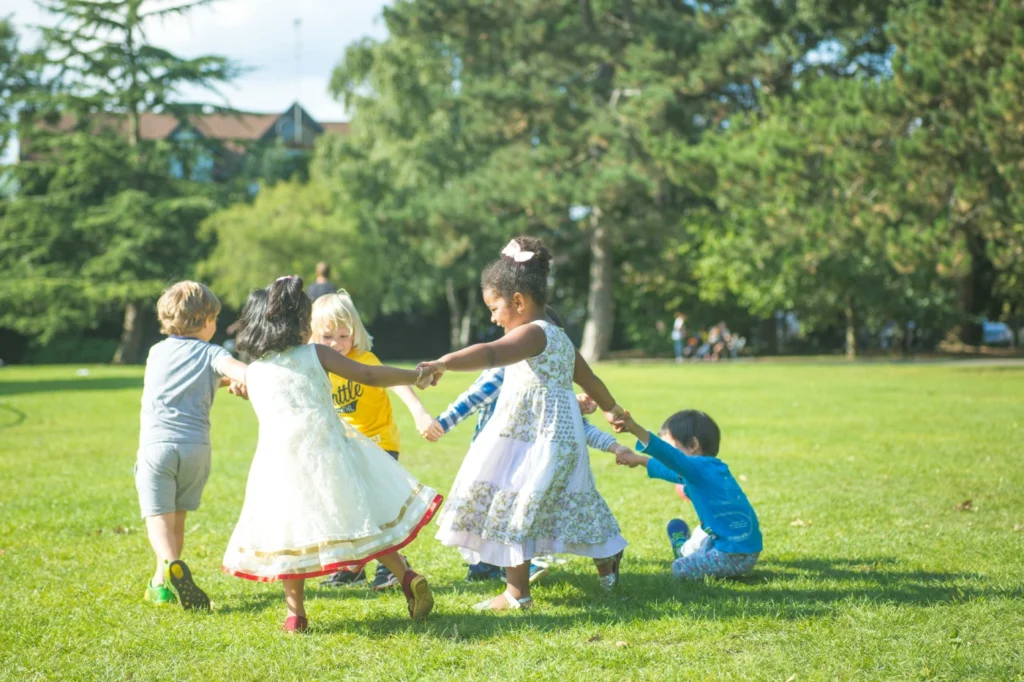
Unstructured play with peers confronts children with situations that require emotional and social management: negotiating rules, managing the disappointment of losing, finding a way back in after being excluded, coping with a scraped knee. These are not side effects of play; they are the curriculum. Outdoor play is almost always social play, so it builds communication, leadership, compromise and conflict resolution in real time, without an adult managing every interaction.
Does outdoor play help with academics?
Yes. Unstructured outdoor settings demand creative thinking, a stick becomes a sword, a bridge or a measuring tool, and children who play this way score higher on creative problem-solving. The outdoors is also a science and maths classroom: observing insects and weather builds naturalistic intelligence, while building dams or sorting pebbles introduces mathematical thinking in a concrete way. Several of the top CBSE schools in Bangalore report that children with rich outdoor experience engage with science and maths more deeply.
How outdoor play builds social skills
| Social skill | How outdoor play builds it |
|---|---|
| Communication | Children explain rules, negotiate roles and resolve disputes verbally |
| Leadership | Group play creates chances to organise and motivate |
| Empathy | Social friction and repair build understanding of others |
| Compromise | Games break down without it; children learn its value directly |
| Conflict resolution | Disputes arise, and navigating them builds a skill adult life demands |
How much outdoor play do children need?
The World Health Organization recommends at least 60 minutes of moderate-to-vigorous physical activity daily for children aged 5 to 17, much of it unstructured outdoor play. Children under 5 who can walk should be active for at least three hours spread across the day. Families near the schools in Bangalore that run strong outdoor programmes get part of this at school, but the balance must also be met at home through evening play and weekend outings. See how we build it into the day at BRS Global School on our beyond the classroom page.
Frequently Asked Questions (FAQs)
Can indoor play replace outdoor play in bad weather?
Indoor play has value but does not fully replace outdoor play. Nature, varied terrain, sunlight and large open spaces are specific to the outdoors, so return to outdoor play as soon as conditions allow.
How much should be unstructured play versus organised sport?
Both matter. Organised sport builds teamwork and skill; unstructured play builds creativity and self-regulation. Children benefit most from a mix with enough unstructured time to develop imagination and self-direction.
At what age does outdoor play matter most?
It matters at every age, but the early years (2 to 8) are critical because motor, social and cognitive patterns form then. Adolescents also benefit, particularly for stress regulation and mental health.
My child prefers playing indoors. Should I force outdoor time?
Gentle encouragement works better than force. Invite a friend, join them yourself, or find a park linked to their interests. Making outdoor time appealing builds habit; forcing it builds resistance.
Is screen time a substitute for outdoor play?
No. Screens engage the visual and cognitive systems but not the motor, sensory and proprioceptive systems that outdoor play activates. They serve different functions and both have their place.
Conclusion
Outdoor play is not a reward for finishing homework or wasted time between lessons. It is one of the most efficient developmental activities available, building physical, mental, emotional, social and cognitive capacities at once. How a school treats outdoor time is a meaningful sign of how seriously it takes the whole child. To see how BRS Global School protects it, enquire about admissions or contact us.