
Introduction: Making Mathematics Meaningful Through Montessori Learning
Mathematics becomes easier to understand when children can connect numbers with real experiences. During the early years, simply memorising number names or repeating calculations may not always help children understand what numbers actually represent. Young learners benefit from opportunities to explore quantities, recognise patterns and discover how numbers relate to one another.
This is where Montessori arithmetic materials play an important role. Instead of beginning exclusively with written sums, children interact with carefully selected learning materials that make mathematical concepts visible and tangible. They can count objects, compare quantities, arrange number sequences and explore relationships between numbers through practical activities.
At BRS Global School | Best CBSE School in Sarjapur Road, the Montessori approach encourages children to participate actively in their learning. By working with physical materials, young learners can gradually develop a clearer understanding of mathematical ideas while strengthening concentration, coordination and independent thinking.
For parents exploring schools in Sarjapur Road, understanding how mathematics is introduced during the foundational years can offer valuable insight into a school’s approach to early childhood education. The way children experience mathematics at this stage can influence their confidence, curiosity and readiness to approach more complex concepts later.
Event Overview: Montessori Arithmetic Learning
What is the purpose of Montessori arithmetic activities?
The purpose is to help children understand mathematical concepts through practical exploration before moving towards abstract calculations. These activities connect numbers with quantities and encourage children to discover mathematical relationships through observation, repetition and independent practice.
School : BRS Global School
Campus : Sarjapur Road, Kasavanahalli, Bengaluru
Learning area : Montessori Arithmetic
Educational approach : Hands-on, concrete mathematical exploration
Key concepts : Counting, quantities, number symbols, place value and mathematical operations
Developmental focus : Number sense, fine-motor skills, concentration, logical thinking and confidence
The activities use Montessori arithmetic materials to help children explore mathematics at a developmentally appropriate pace. Rather than treating mathematics only as a written subject, this approach creates opportunities for children to engage with numbers through purposeful activity.
What Happens During Montessori Arithmetic Activities?
Montessori arithmetic activities give children opportunities to handle materials, observe patterns, compare quantities and practise mathematical concepts. The specific activity depends on the material being used and the child’s stage of learning.
Making Mathematics Concrete
Young children often understand an idea more easily when they can see and touch it. Montessori arithmetic materials allow them to represent quantities physically instead of relying entirely on number symbols.
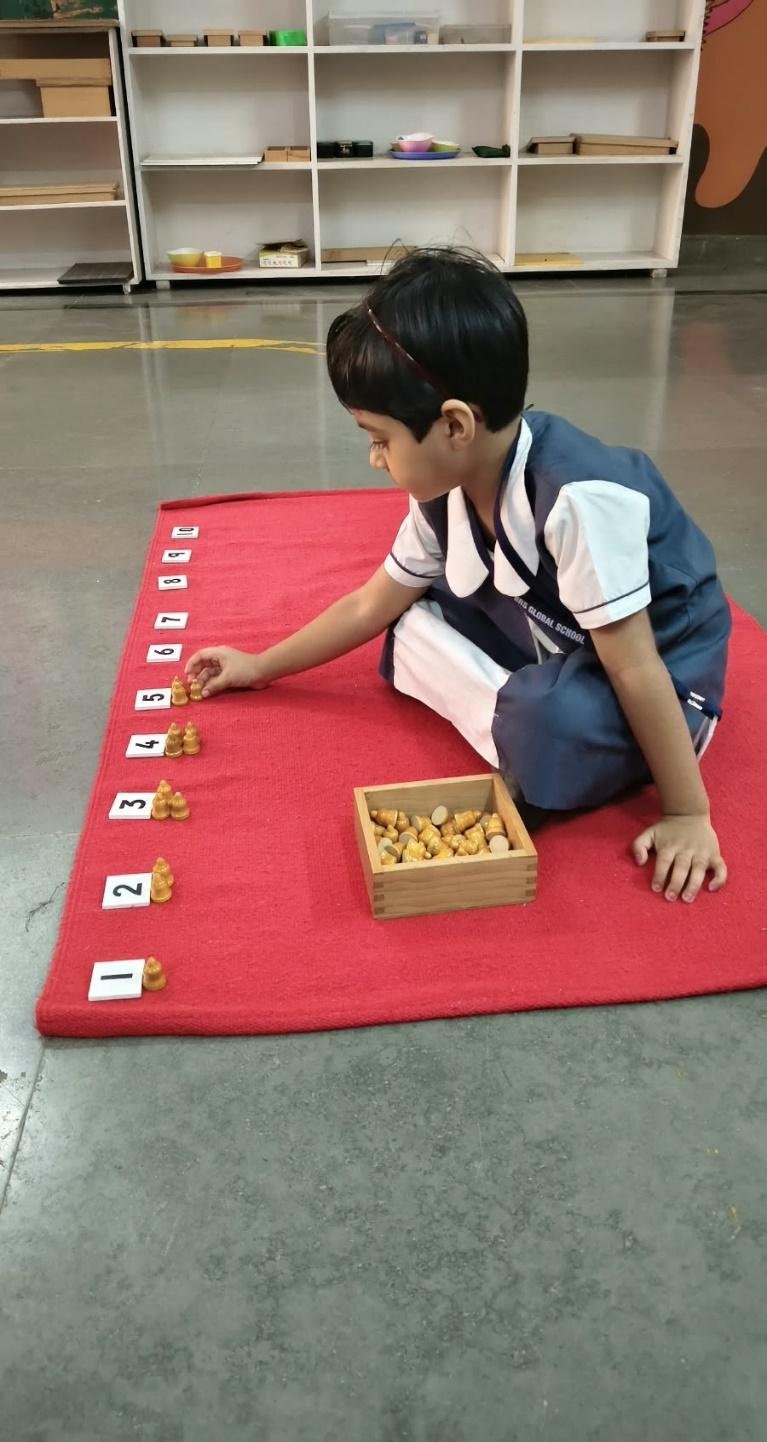
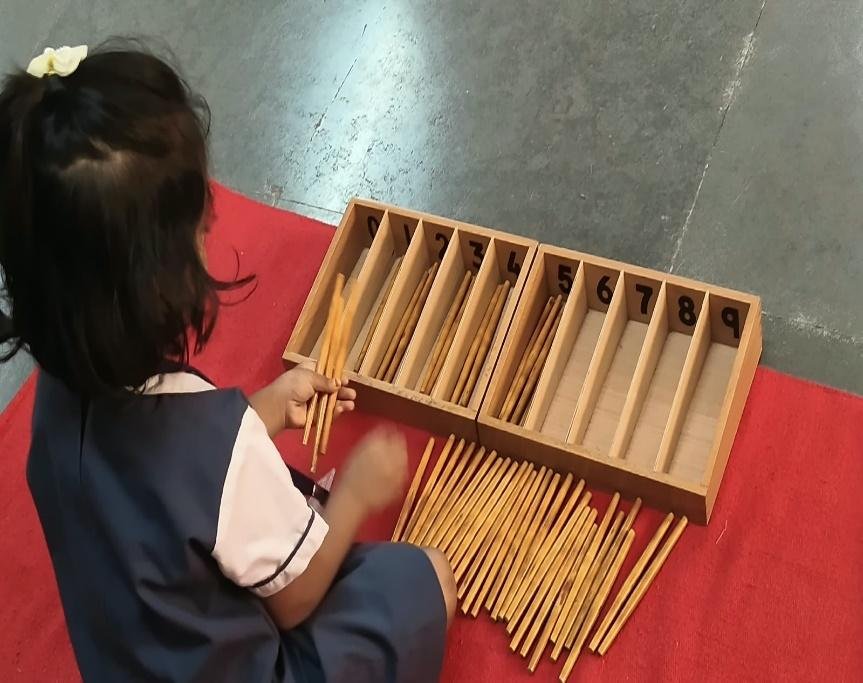
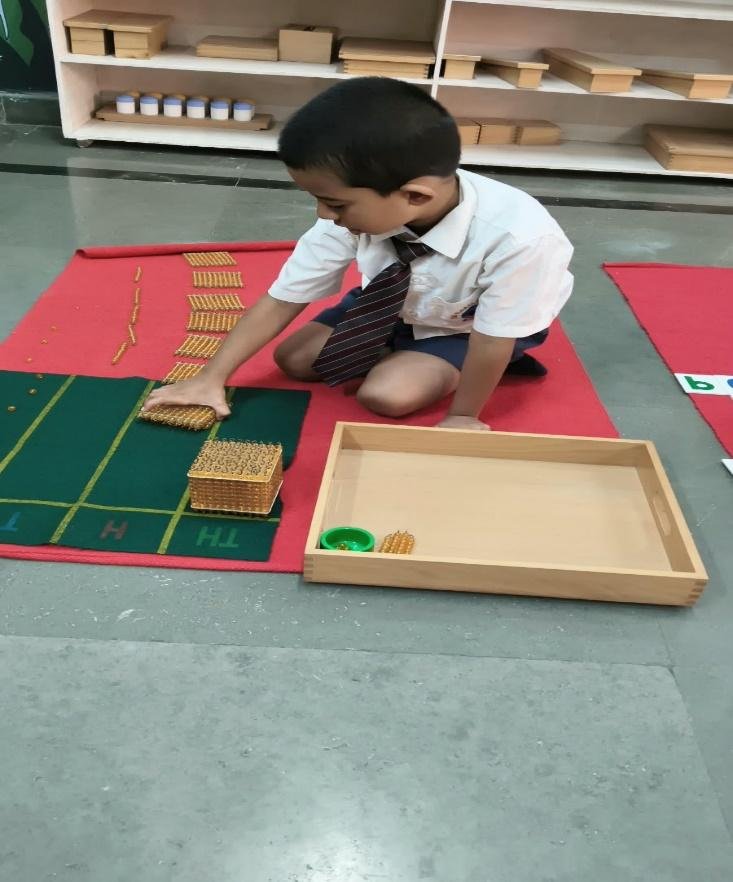
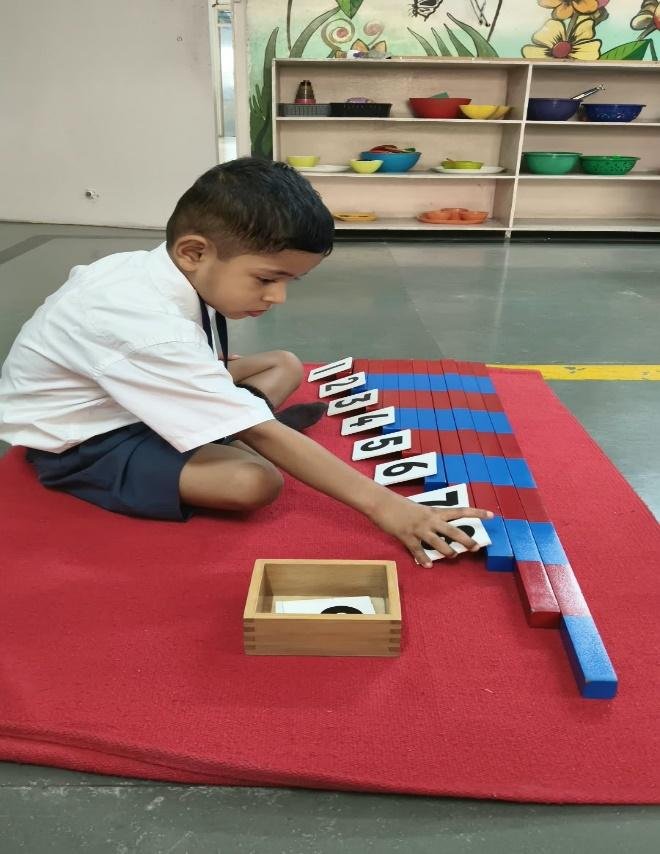
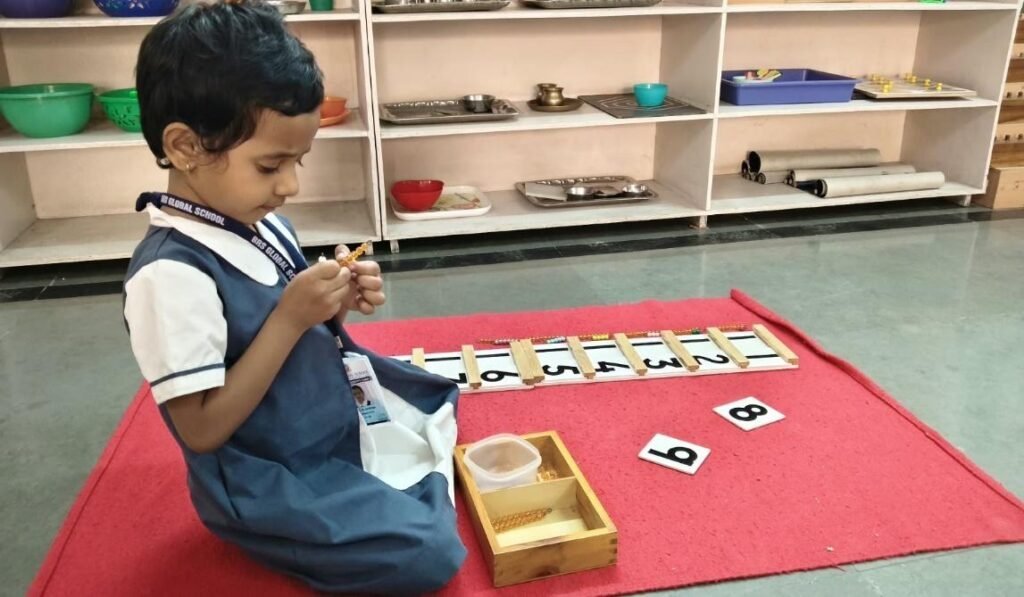
For example, children can arrange counters to represent a number or use rods and beads to compare quantities. These experiences help connect a written numeral with the quantity it represents.
This connection is an important foundation for later mathematical learning because children begin to understand the meaning behind numbers rather than simply memorising them.
Building Number Sense
Number sense involves understanding numbers, quantities, counting and the relationships between different numbers.
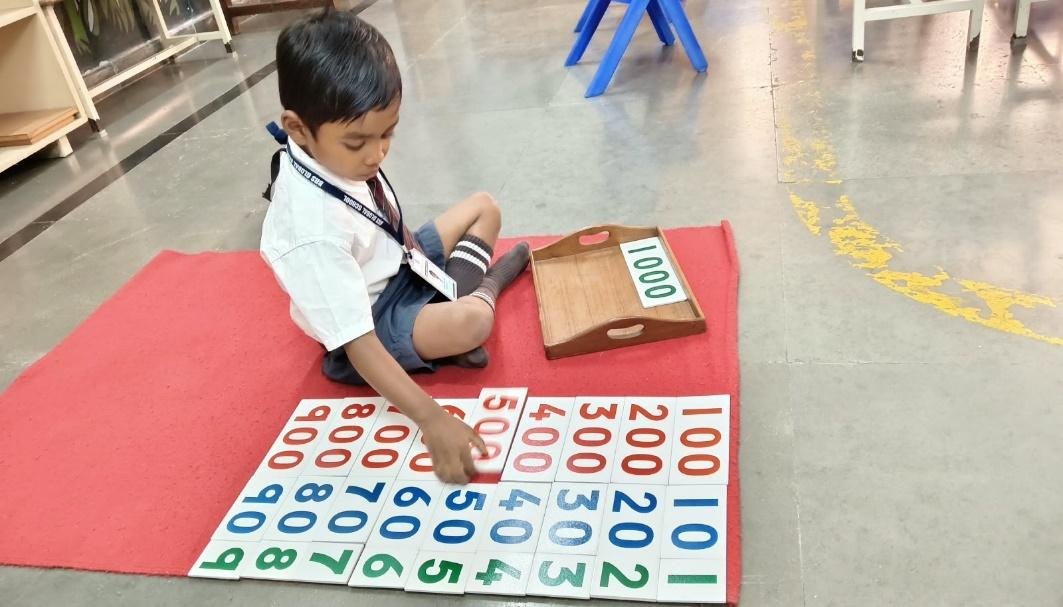
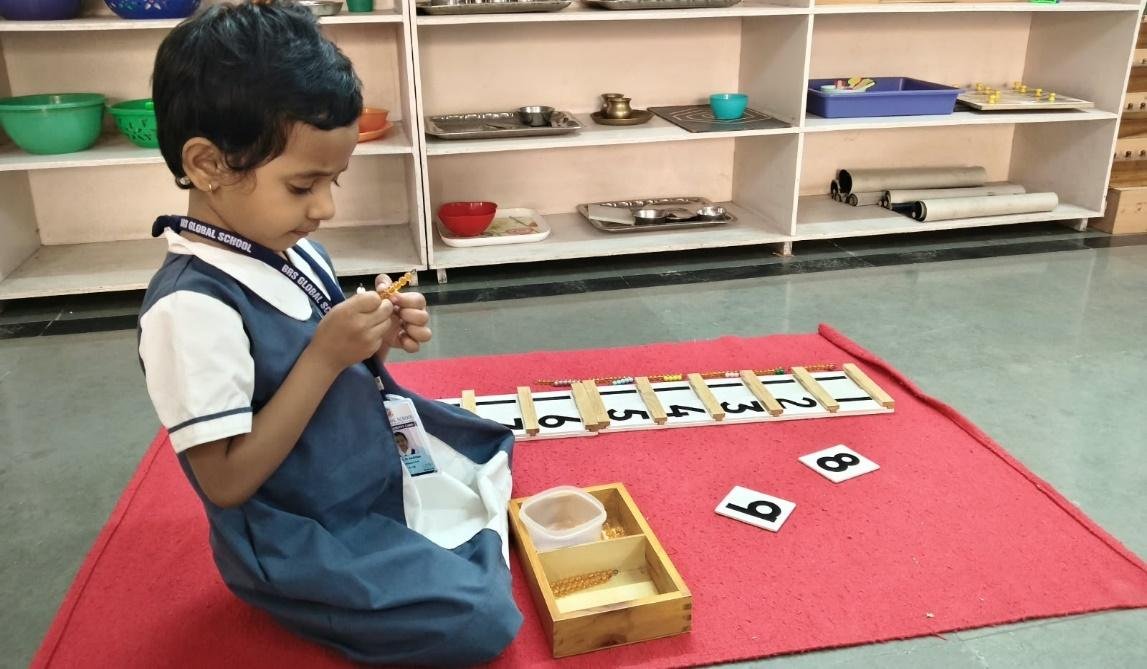
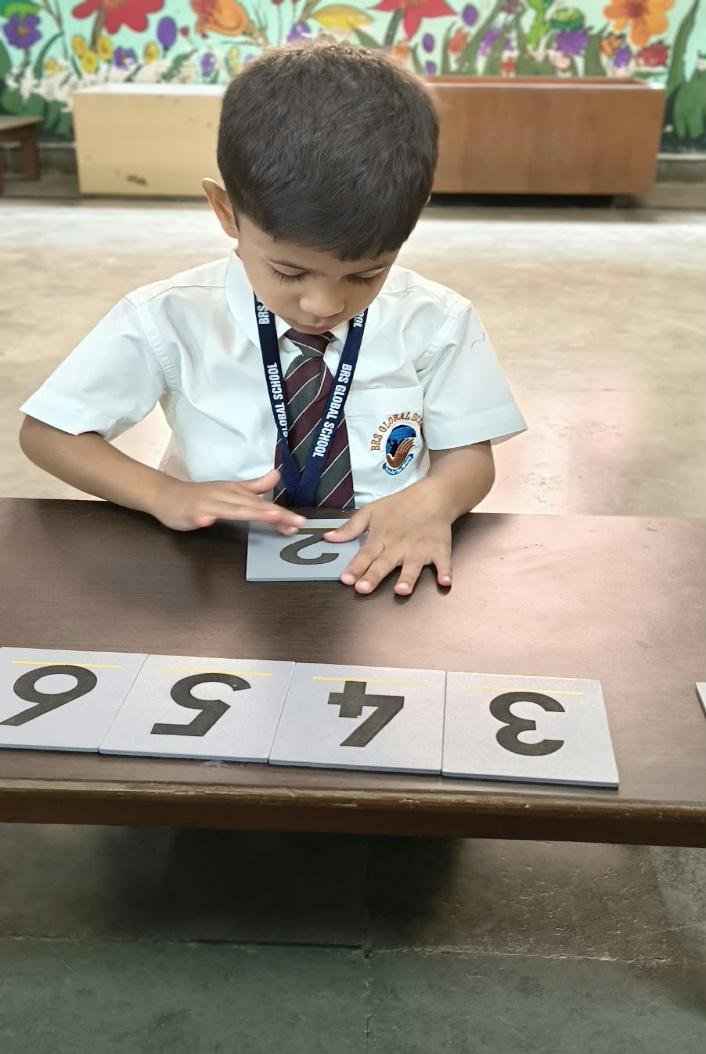
Montessori materials provide opportunities to count objects, match quantities with numerals, identify sequences and compare groups. Repeated engagement with these activities helps children become familiar with how numbers work.
A child who understands that a number represents a specific quantity is better positioned to explore mathematical relationships and calculations as learning progresses.
Developing Fine-Motor Skills
Handling small arithmetic materials such as beads, counters and cards requires controlled hand movements and visual attention.
These activities provide opportunities to practise picking up, placing, arranging and sorting objects. Such movements can support fine-motor coordination, which is also useful for activities such as drawing, writing and manipulating classroom materials.
Encouraging Concentration
Montessori arithmetic activities often involve completing a sequence of steps, arranging materials carefully or checking a result.
As children engage with these tasks, they have opportunities to practise sustained attention, patience and orderly working habits. Repeating an activity can also help them become more familiar with a concept and more comfortable completing tasks independently.
Introducing Mathematical Operations
Montessori arithmetic materials can help children explore addition, subtraction, multiplication and division through quantities and physical arrangements.
Children may begin by combining groups, removing objects, arranging equal groups or sharing quantities. These experiences make the relationships behind mathematical operations easier to observe.
As understanding develops, children can progress towards number sentences and written calculations.
Supporting Logical Thinking
Mathematics involves identifying relationships, recognising patterns and making sense of information.
Through arithmetic activities, children can arrange objects in order, identify sequences, compare quantities and explore what changes when materials are added or removed. These experiences encourage observation, reasoning and problem-solving.
Encouraging Independent Learning
Working with Montessori materials gives children opportunities to practise at their own pace. Depending on the material and activity, they may be able to identify a mistake, rearrange the objects and try again.
This process encourages persistence and gives children an active role in their learning. It also helps them become more comfortable exploring a problem instead of immediately depending on an adult to provide the answer.
Bridging Concrete and Abstract Learning
One of the important purposes of Montessori arithmetic is to support the transition from physical materials to mental understanding and written calculations.
Children first explore quantities using objects. With experience, they can begin connecting these quantities to symbols and mathematical operations, gradually progressing towards solving problems mentally or on paper.
The transition depends on each child’s readiness and understanding. Hands-on materials provide a foundation for abstract thinking rather than replacing written mathematics.
Building Confidence in Mathematics
Children may feel more comfortable attempting a mathematical task when they can explore it physically and learn through repeated practice.
Successfully completing an activity can encourage them to try a new challenge, revisit a difficult concept or work independently. These experiences can help make mathematics feel more approachable and enjoyable.
The goal is not simply to obtain the correct answer but to help children understand the process that leads to it.
Student Learning Outcomes and Benefits
Montessori arithmetic materials contribute to several interconnected areas of early learning.
• Conceptual understanding: Children can develop a clearer connection between numbers, quantities and mathematical symbols.
• Reasoning and problem-solving: Arranging materials, identifying patterns and exploring number relationships encourage logical thinking.
• Fine-motor coordination: Handling beads, rods, counters and cards gives children opportunities to practise precise hand movements.
• Concentration and persistence: Completing activities encourages children to focus, follow steps and try again when necessary.
• Independent learning: Children can practise concepts at their own pace and take an active role in discovering solutions.
• Mathematical confidence: Familiarity with quantities and operations can help children approach new mathematical challenges with greater confidence.
These outcomes are interconnected. For example, when a child arranges objects to represent a number, the activity may involve counting, hand coordination, concentration and checking whether the quantity matches the numeral.
The learning value therefore extends beyond the mathematical answer alone.
Educational Philosophy: Learning Through Experience
The Montessori approach places importance on active participation, purposeful materials and opportunities for children to explore concepts through experience.
In arithmetic, this means helping children develop an understanding of numbers before expecting them to work exclusively with abstract symbols. Physical materials provide a bridge between what children can observe and the mathematical ideas they are learning.
At BRS Global School | Best CBSE School in Sarjapur Road, this approach supports an engaging early learning environment in which children can explore, practise and develop their understanding progressively.
The approach also recognises that children may need different amounts of time to become comfortable with a concept. Repeated practice, appropriate guidance and opportunities for independent exploration can help them build a stronger foundation.
For parents, the important consideration is whether learning activities encourage children to understand what they are doing, explain their thinking and apply their knowledge as they progress.
How Does Montessori Arithmetic Relate to Foundational Learning?
Montessori arithmetic activities support foundational numeracy by connecting quantities, number symbols and mathematical relationships through practical experiences.
This emphasis on understanding is consistent with the broader educational aim of developing foundational mathematical abilities rather than relying only on memorisation. The materials can complement classroom instruction and help children prepare for increasingly complex mathematical concepts.
They should be viewed as one component of a broader educational experience that includes teacher guidance, age-appropriate activities, language development, social interaction and opportunities to apply learning.
Why Is Hands-On Mathematics Important for Child Development?
Early mathematics involves more than recognising numbers. Children also need opportunities to compare, classify, sequence, reason and understand relationships.
Hands-on arithmetic materials create practical situations in which these abilities can be exercised. When children arrange objects, compare groups or investigate a numerical pattern, they actively participate in the learning process.
This approach can be valuable for children who benefit from visual and tactile experiences. It also gives teachers opportunities to observe how a child approaches a task, identify areas that need additional practice and introduce the next concept when appropriate.
Parents can reinforce this learning at home through everyday experiences, such as counting fruits, sorting toys, comparing the number of objects in two groups or sharing items equally.
Simple activities can encourage children to think mathematically without making every interaction feel like a formal lesson.
Local Context: Montessori Learning at BRS Global School, Sarjapur Road
Families exploring schools in Sarjapur Road often consider several factors when choosing an educational environment, including the curriculum, foundational learning approach, accessibility and opportunities for holistic development.
BRS Global School | Best CBSE School in Sarjapur Road, campus, located in Kasavanahalli, serves families in and around Sarjapur Road and nearby residential communities. Depending on their location and commute, families from Bellandur, HSR Layout, Haralur Road, Harlur, Carmelaram, Doddakannelli, Gunjur, Varthur, Choodasandra and Kodathi may also consider schools in this area.
For families comparing CBSE schools in Sarjapur Road, understanding how a school approaches foundational learning can be as important as reviewing its academic programme and facilities.
Montessori arithmetic materials offer one example of how mathematical understanding can be introduced through purposeful activities during the early years. Parents may wish to learn how such activities fit into the school’s broader Montessori and kindergarten learning approach.
Explore the Sarjapur Road campus: BRS Global School – Sarjapur Road Google Business Profile
BRS Global School also has a separate Attibele branch. Families specifically looking for schools in Attibele can explore the BRS Global School – Attibele Google Business Profile. This is a different campus from the Sarjapur Road branch featured in this article.
Common Parent Questions About Montessori Arithmetic
How do Montessori materials help children understand numbers?
Montessori materials allow children to represent quantities physically and connect them with number symbols. Counting, arranging and comparing objects help children explore the meaning of numbers through direct experience.
Can hands-on activities help children who find mathematics difficult?
Hands-on activities may help children who benefit from visual and tactile learning experiences. Physical materials can make quantities and relationships easier to explore, although individual learning needs and progress vary.
Does Montessori arithmetic include written calculations?
Yes. Montessori arithmetic supports a gradual transition from concrete materials to number symbols and written calculations. Physical materials help children build understanding; they do not replace the need to develop fluency with mathematical symbols.
What can parents do at home?
Parents can encourage everyday numeracy by counting household objects, sorting items by size, comparing quantities and sharing objects equally. These activities create natural opportunities to discuss numbers and mathematical relationships.
Why should parents consider the way mathematics is taught in the early years?
A strong early learning approach helps children develop conceptual understanding, reasoning and confidence alongside basic number skills. Parents can ask how the school introduces new concepts, supports children who need more practice and progresses towards written mathematics.
Key Highlights
• Montessori arithmetic materials make mathematical quantities visible and tangible.
• Children explore counting, number symbols, number sense and place value.
• Beads, rods, cards and counters provide opportunities for hands-on practice.
• Activities can support fine-motor coordination and concentration.
• Physical materials help introduce addition, subtraction, multiplication and division.
• Pattern recognition and sequencing encourage logical thinking.
• Independent practice allows children to explore concepts at their own pace.
• Concrete experiences support the gradual transition to abstract calculations.
• Successful learning experiences can help children approach mathematics with greater confidence.
Frequently Asked Questions (FAQs)
What age group is Montessori arithmetic suitable for?
Montessori arithmetic is generally introduced during the early childhood years, with materials and activities selected according to a child’s developmental stage, readiness and prior understanding.
What are examples of Montessori arithmetic materials?
Examples include counting beads, number rods, number cards and counters. Different materials support different concepts, from counting and quantity recognition to exploring mathematical operations.
How do Montessori materials improve number sense?
They help children connect a numeral with the quantity it represents. Counting, matching, comparing and arranging materials provide practical opportunities to understand number relationships.
Can Montessori arithmetic help develop problem-solving skills?
Yes. Activities involving patterns, sequences, quantities and mathematical operations encourage children to observe, reason, test ideas and work towards solutions.
How do Montessori arithmetic activities support school readiness?
They can help children become familiar with counting, quantities, number symbols and early mathematical relationships. These experiences provide a foundation for progressing towards more formal mathematics instruction.
Is Montessori arithmetic different from learning mathematics through worksheets?
Montessori arithmetic places particular emphasis on concrete, hands-on exploration before moving towards abstract work. Worksheets can also be useful, but physical materials offer another way for children to investigate and understand mathematical concepts.
How can parents learn more about the Montessori programme at BRS Global School?
Parents can contact or visit the Sarjapur Road campus to learn more about the school’s early childhood learning approach, classroom activities and admissions process.
Conclusion: Building Confidence Through Foundational Learning
A child’s early experience of mathematics can help shape how they approach numbers, challenges and new ideas. Montessori arithmetic materials provide opportunities to move beyond memorisation by connecting mathematical concepts with physical experiences, observation and independent practice.
From developing number sense to exploring mathematical operations, these activities help children build a foundation for more advanced learning while practising concentration, coordination and logical thinking.
At BRS Global School, Sarjapur Road parents can explore how Montessori and kindergarten learning experiences contribute to children’s foundational development.
Explore our Campus:
Attibele Branch:
https://share.google/iFhJaeGo8wkgOZ1Y5
Sarjapur Road Branch: