
Introduction: Making Mathematics Meaningful Through Montessori Learning
Mathematics becomes more meaningful when children can explore concepts rather than simply memorise numbers and rules. In the early years, opportunities to touch, arrange, count and compare objects help young learners connect mathematical symbols with real quantities.
At BRS Global School | Best CBSE School in Sarjapur Road Campus, Montessori arithmetic materials provide a practical way for children to explore foundational mathematical concepts. Through structured, hands-on activities, children can investigate numbers, recognise patterns, understand quantities and develop familiarity with basic mathematical operations.
This approach recognises that children benefit from building understanding step by step. Before working confidently with abstract calculations, they need opportunities to explore what numbers represent and how quantities relate to one another.
For parents exploring schools in Sarjapur Road, understanding how early mathematics is introduced can offer valuable insight into a school’s learning approach. A meaningful early-years mathematics experience should help children develop understanding, curiosity and confidence rather than focus solely on completing worksheets.
Montessori arithmetic supports these goals by combining practical exploration with opportunities for independent practice and gradual progression.
Event Overview: Montessori Arithmetic Materials
Activity: Montessori Material Exploration
Subject: Arithmetic
Learning approach: Hands-on, concrete and child-centred exploration
Campus: BRS Global School, Sarjapur Road, Kasavanahalli, Bengaluru
Primary learning focus: Number sense, mathematical understanding, concentration, logical thinking and independence
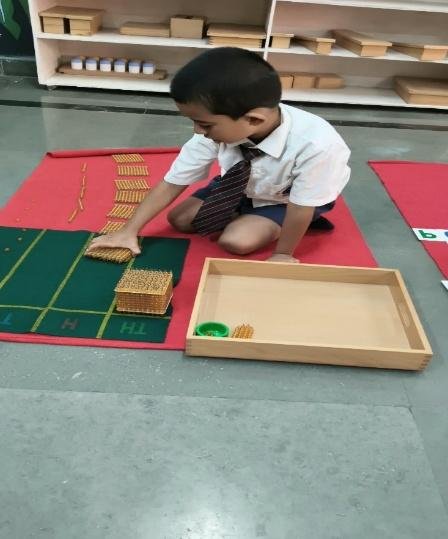
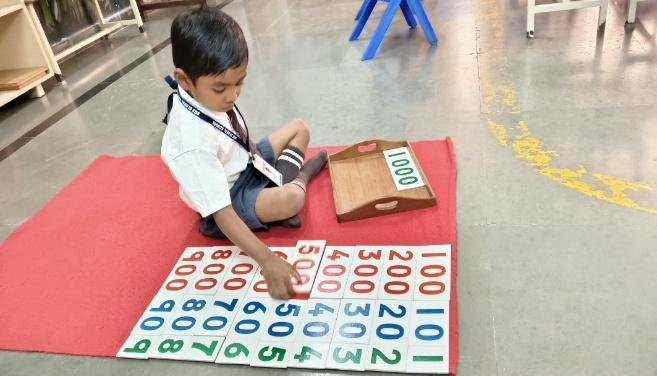
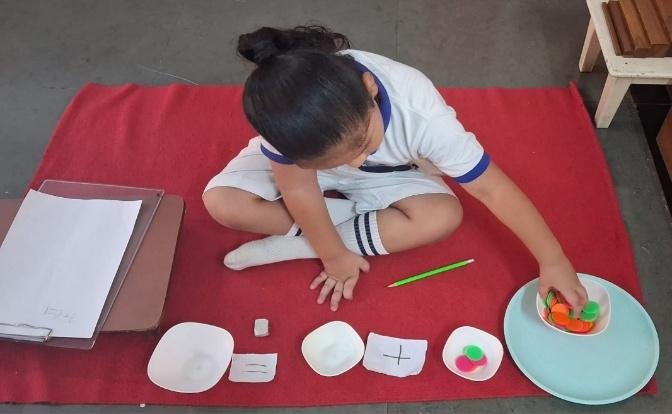
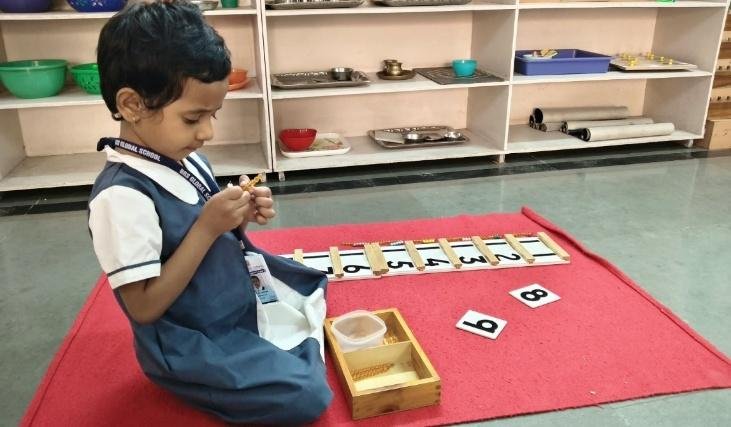
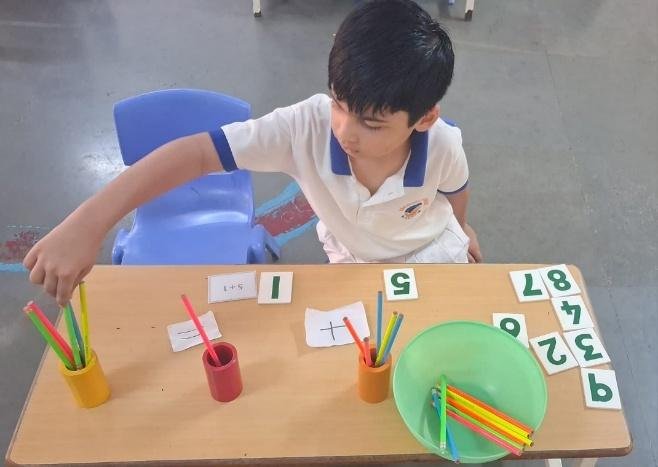
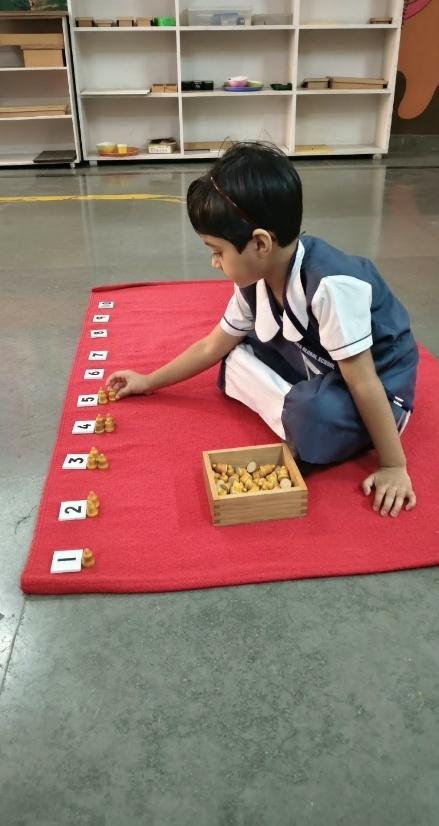
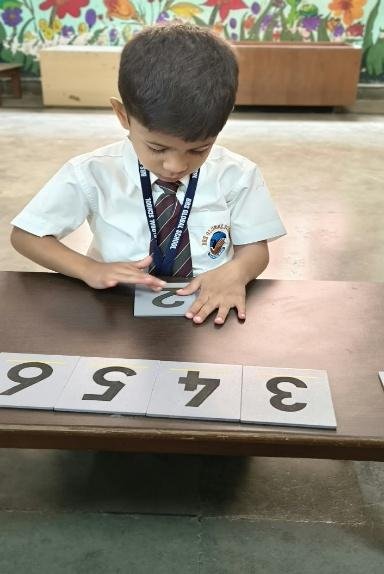
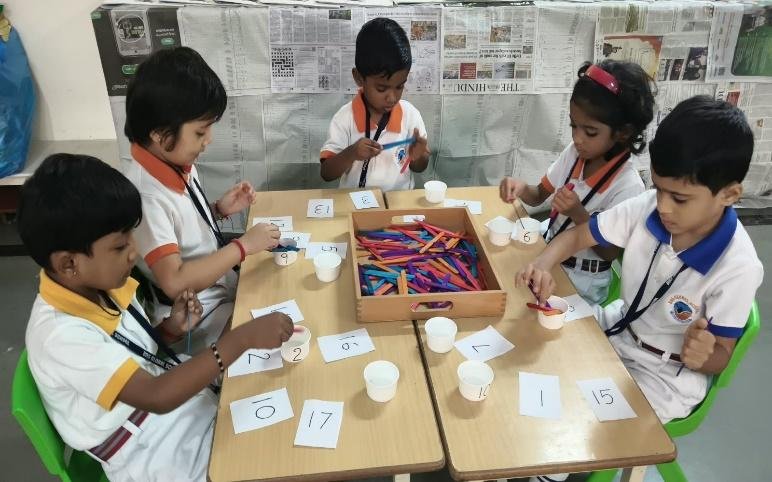
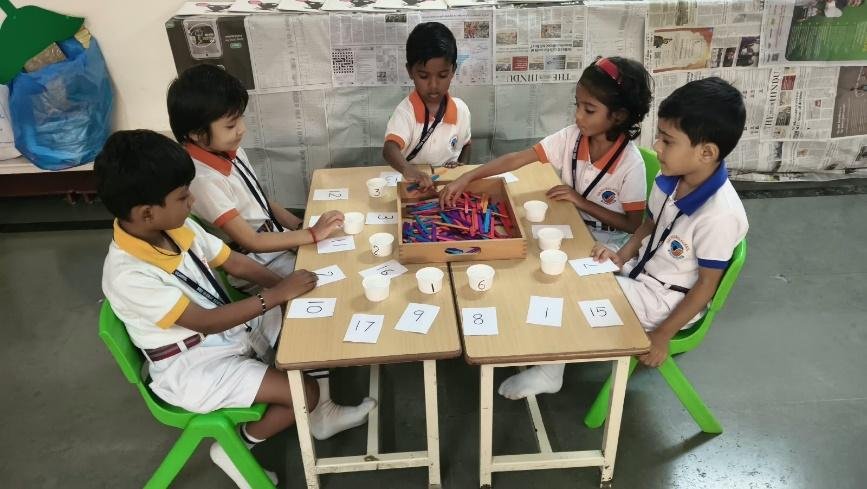
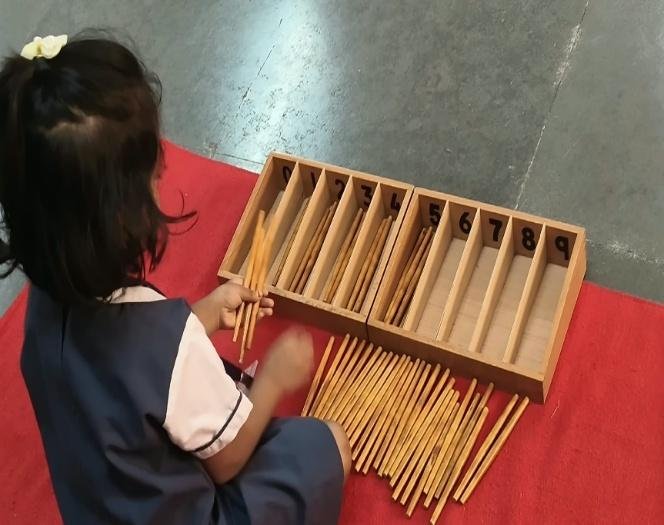
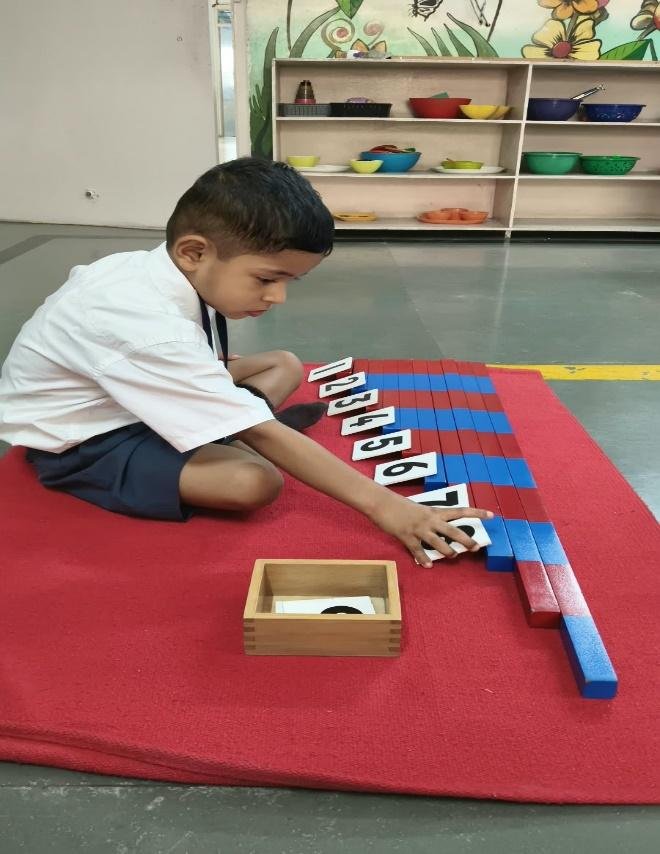
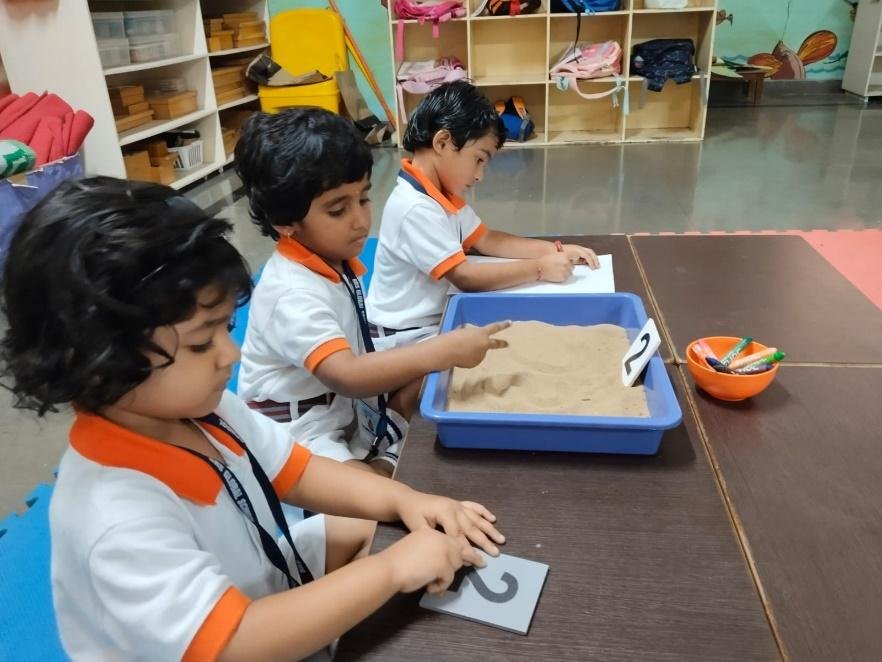
The Montessori arithmetic approach uses physical materials to introduce mathematical ideas in a way young learners can explore. Beads, rods, cards and counters are examples of materials that can help children connect quantities with number symbols and mathematical relationships.
Rather than treating mathematics as a collection of abstract rules, these materials provide a starting point for observation, manipulation and discovery. Children can work with quantities, compare groups, arrange sequences and explore how numbers relate to each other.
The purpose is not simply to help children arrive at a correct answer. It is also to help them understand the process behind that answer.
At BRS Global School‘s Sarjapur Road campus, this learning approach aligns with the broader objective of supporting early mathematical development through meaningful educational experiences.
What Do Children Learn Through Montessori Arithmetic Materials?
Making Mathematics Concrete
Young children often find abstract mathematical symbols difficult to understand when they have not yet developed a clear sense of quantity.
Montessori materials help bridge this gap by allowing children to work with physical representations of numbers. They can observe quantities, move objects and compare groups before progressing towards written calculations.
For example, counters can help a child understand that a group of five contains one more object than a group of four. Such experiences connect numerical symbols with observable quantities.
Learning benefit: Children develop a clearer understanding of what numbers represent.
Building Number Sense and Place Value
Number sense involves understanding quantities, recognising numerical relationships and developing an intuitive understanding of numbers.
Using appropriate arithmetic materials, children can explore counting, quantity, number symbols and, as their learning progresses, place value. These experiences help them recognise that numbers represent quantities and that the position of a digit affects its value.
Repeated opportunities to arrange and compare quantities can strengthen this foundation.
Learning benefit: Children develop a stronger understanding of numbers and their relationships.
Developing Fine-Motor Skills
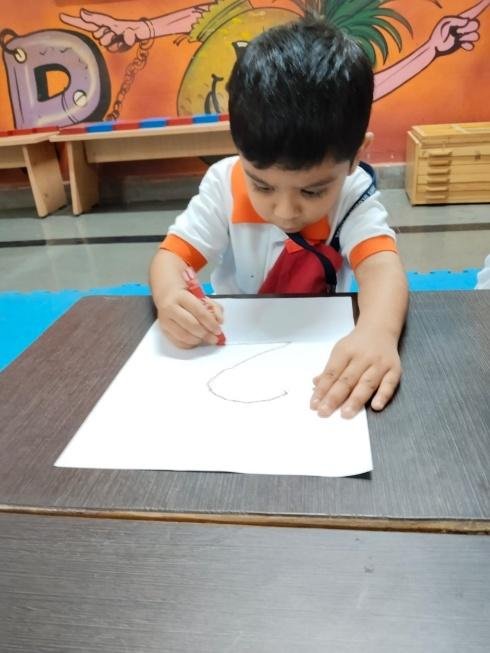
Handling small educational materials requires children to use controlled hand and finger movements. Picking up beads, arranging counters, positioning cards and moving rods provide opportunities to practise coordination.
These activities involve more than mathematical thinking. They also require children to handle objects carefully and coordinate their movements with visual information.
Fine-motor development supports many everyday classroom activities, including manipulating learning materials and beginning written work.
Learning benefit: Children practise hand control, coordination and precision.
Encouraging Concentration
Montessori arithmetic activities often involve arranging materials, following a sequence and completing a task carefully.
Children need to pay attention to quantities, observe differences and make deliberate movements. When an activity is appropriately matched to their developmental stage, it can provide an opportunity to practise sustained attention.
Concentration develops over time through repeated opportunities to engage with purposeful tasks.
Learning benefit: Children practise focus, patience and completing activities carefully.
Introducing Mathematical Operations
Arithmetic materials can help children explore the meaning behind addition, subtraction, multiplication and division.
For example, counters can be combined to demonstrate addition or separated into groups to explore subtraction. Equal groups can introduce early ideas related to multiplication, while sharing objects equally can help illustrate division.
These concrete experiences provide a foundation for understanding the operations before children increasingly rely on number symbols and written methods.
Learning benefit: Children begin to understand how mathematical operations work.
Strengthening Logical Thinking
Mathematics involves identifying relationships, recognising patterns and making connections between quantities.
When children arrange materials in sequences, compare groups or explore numerical patterns, they practise observing information and deciding what comes next.
These experiences encourage children to look for relationships instead of approaching each task as an unrelated exercise.
Learning benefit: Children develop early reasoning and pattern-recognition skills.
Encouraging Independent Learning
Age-appropriate Montessori materials can support independent practice by giving children a tangible way to explore a task.
Children may arrange materials, check their work against an activity’s instructions or repeat an exercise to strengthen their understanding. Depending on the material and the activity, opportunities for self-correction can also help children recognise and address mistakes.
Independence does not mean learning without guidance. Educators continue to provide demonstrations, support and feedback when needed.
Learning benefit: Children practise initiative, responsibility and self-directed learning.
Moving from Concrete to Abstract Learning
One of the important purposes of Montessori arithmetic is to help children gradually move from physical experiences towards mental calculations and written mathematics.
Initially, children may use objects to represent quantities. As their understanding develops, they can begin connecting these quantities to number symbols and eventually solve problems with less physical support.
This progression helps connect practical experiences with more abstract mathematical ideas.
Learning benefit: Children build a foundation for increasingly complex mathematical learning.
Building Mathematical Confidence
Children are more likely to engage positively with mathematics when they have opportunities to explore concepts at an appropriate pace and understand what they are doing.
Hands-on materials can make early mathematical ideas more approachable by giving children something tangible to work with. Repeating activities and gradually mastering new concepts can also support a sense of achievement.
Confidence develops through understanding, practice, encouragement and constructive feedback.
Learning benefit: Children can approach early mathematics with greater confidence and curiosity.
How Does Montessori Arithmetic Support Children's Learning?
Montessori arithmetic materials support early mathematical development by connecting physical experiences with numerical ideas. Children can explore quantities, identify relationships and practise operations before progressing towards increasingly abstract representations.
The learning process can be understood through four stages:
Explore: Children handle materials and observe quantities.
Understand: They connect quantities with numbers and mathematical relationships.
Practise: They repeat activities, compare results and strengthen their understanding.
Apply: They gradually use their understanding in mental calculations and written problems.
This progression gives children opportunities to build understanding instead of relying entirely on memorised procedures.
For parents, the key distinction is that hands-on mathematics is not simply play with educational objects. When guided by a clear learning objective, it becomes a structured opportunity to develop mathematical understanding.
At BRS Global School, Sarjapur Road Campus, the Montessori arithmetic approach reflects the importance of introducing foundational concepts through practical learning experiences.
How Does Montessori Arithmetic Align with Early Learning Principles?
Early childhood education benefits from learning experiences that are meaningful, age-appropriate and responsive to children’s developmental needs.
Montessori arithmetic materials can support these principles by allowing children to explore mathematical concepts through physical interaction, observation and practice.
The approach also connects with the broader emphasis on foundational numeracy in India’s National Education Policy (NEP) 2020 and the National Curriculum Framework for the Foundational Stage (NCF-FS), which recognise the importance of developing early mathematical understanding through appropriate learning experiences.
The connection is educational rather than a claim that any single material guarantees a particular outcome. Effective learning depends on appropriate activities, teacher guidance, regular practice and the individual needs of each child.
When mathematical concepts are introduced through concrete experiences, educators can help children establish a foundation for later classroom learning.
Why Is Early Mathematics Important for Holistic Development?
Early mathematics supports more than the ability to count or calculate. It can also provide opportunities for children to practise reasoning, attention, coordination and independent decision-making.
| Developmental area | How arithmetic activities can help |
|---|---|
| Cognitive development | Encourages comparison, classification and reasoning |
| Mathematical understanding | Builds counting, quantity and number relationships |
| Fine-motor development | Practises controlled movements when handling materials |
| Concentration | Encourages attention to a task and its sequence |
| Independence | Provides opportunities for individual practice |
| Confidence | Helps children experience progress through understanding |
| Problem-solving | Encourages children to explore relationships and possible solutions |
These benefits are complementary. They contribute to a learning environment where children can develop foundational academic skills alongside habits that support their wider educational journey.
For families considering schools in Bellandur, Kasavanahalli, HSR Layout or Haralur Road, it can be useful to look beyond textbook coverage and understand how a school introduces concepts during the early years.
Why This Learning Approach Matters to Parents
Parents often want to know whether their child is developing a genuine understanding of mathematics or simply learning to repeat answers.
Hands-on arithmetic offers a way to make early mathematical learning more visible. Children can demonstrate what they understand by arranging quantities, comparing groups, explaining patterns and showing how a calculation works with physical materials.
Parents can support this learning at home through simple everyday activities:
• Counting: Count fruits, toys or household objects together.
• Comparing: Ask which group has more or fewer objects.
• Sorting: Group objects according to size, colour or shape.
• Sharing: Divide snacks or toys equally among family members.
• Recognising patterns: Arrange objects in a repeating sequence and ask what comes next.
• Everyday problem-solving: Ask questions such as, “If we have three apples and add one more, how many will there be?”
These activities need not become formal lessons. Short, enjoyable interactions can help children connect mathematical ideas with everyday experiences.
The aim is to encourage curiosity and understanding while allowing children to develop at a suitable pace.
Local Context: Montessori Learning at BRS Global School, Sarjapur Road
BRS Global School‘s Sarjapur Road campus is located in Kasavanahalli, Bengaluru, serving families exploring educational options in the surrounding communities.
Parents researching schools in Sarjapur Road may also be considering access from Bellandur, HSR Layout, Haralur Road, Hosa Road, Carmelaram, Doddakannelli, Kaikondrahalli, Gunjur and Varthur.
For families living in these areas, evaluating a school involves more than location. Parents may also wish to understand its early-years curriculum, teaching approach, classroom experiences and support for children’s development.
Montessori arithmetic materials offer one example of how foundational learning can be introduced through practical exploration.
Families can learn more about the campus through the BRS Global School Sarjapur Road profile on Google or visit the official school website.
BRS Global School also has a separate Attibele branch. Families interested in that campus can view its Google Business Profile. The Attibele campus is a separate branch, and this article focuses on the Sarjapur Road campus.
Common Parent Questions About Montessori Arithmetic
How is Montessori arithmetic different from learning mathematics through worksheets?
Montessori arithmetic introduces concepts through physical materials that children can handle and explore. Worksheets can help practise and assess understanding, but hands-on activities provide an additional way to understand quantities, number relationships and mathematical operations before or alongside written work.
Does hands-on mathematics help children prepare for formal schooling?
Hands-on mathematics can help children develop foundational understanding of numbers, quantities and simple operations. These foundations can support the transition towards more formal mathematical learning when combined with suitable teaching, practice and age-appropriate progression.
Can children learn independently with Montessori materials?
Children can practise some activities independently once they understand how to use the materials. Teacher demonstrations, observation and guidance remain important, particularly when children encounter new concepts or need additional support.
What can parents observe to understand their child’s progress?
Parents can look for growing confidence in counting, comparing quantities, recognising patterns and explaining simple mathematical relationships. Progress may vary between children, so it is useful to consider understanding and application rather than speed alone.
Key Highlights of the Event
• Montessori arithmetic makes mathematical concepts tangible.
• Beads, rods, cards and counters support practical exploration.
• Children develop number sense and an understanding of quantities.
• Activities introduce foundational mathematical operations.
• Handling materials provides opportunities to practise fine-motor coordination.
• Sequencing and comparison encourage logical thinking.
• Independent practice can support concentration and confidence.
• Concrete experiences help prepare children for abstract calculations.
• Parent participation in everyday counting and sorting activities can reinforce learning.
Frequently Asked Questions (FAQs)
What are prepositions for children?
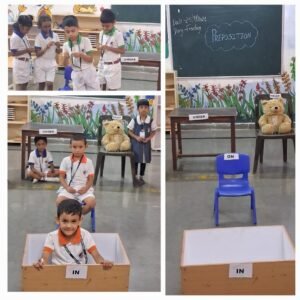
Prepositions are words that help explain the relationship between people, objects and places. In this activity, children learned the positional prepositions in, on, under and near.
How can children learn prepositions easily?
Children can learn prepositions effectively when they encounter them in meaningful situations. Using objects, movement, pictures, role play and simple sentences can help connect the words with their meanings.
What is experiential learning in primary education?
Experiential learning is an approach in which students learn through active participation and experience. It can include activities, demonstrations, role play, hands-on tasks, observation and reflection.
Why is activity-based English learning important?
Activity-based English learning gives children opportunities to use language in context. It can strengthen vocabulary, comprehension, listening and communication while making lessons more engaging.
How does BRS Global School use experiential learning?
At BRS Global School, classroom activities can integrate discussion, participation, hands-on experiences and practice to help students connect concepts with real situations. This prepositions activity is one example of an interactive approach to foundational English learning.
Is BRS Global School located on Sarjapur Road?
Yes. BRS Global School has a Sarjapur Road campus serving families from Sarjapur Road and surrounding communities such as Kasavanahalli, Bellandur, HSR Layout, Haralur Road, Carmelaram, Dommasandra and Gunjur.
What should parents look for when choosing a CBSE school?
Parents may consider curriculum, teaching methodology, learning outcomes, teacher engagement, academic support, communication opportunities, extracurricular experiences, student wellbeing, infrastructure, accessibility and how effectively classroom learning connects with real-world experiences.
Conclusion: Building a Strong Foundation for Mathematical Learning
Early mathematics is most meaningful when children understand the concepts behind the numbers they use. Montessori arithmetic materials provide practical opportunities to explore quantities, recognise patterns, develop logical thinking and gradually move towards abstract calculations.
At BRS Global School, Sarjapur Road Campus, this approach highlights the value of hands-on learning in developing foundational mathematical understanding. Combined with appropriate teacher guidance and regular practice, these experiences can help children build confidence and prepare for more advanced learning.
For parents exploring schools in Sarjapur Road and nearby communities, understanding how a school supports foundational numeracy is an important part of evaluating its early-years educational approach.
Explore our Campus:
Attibele Branch:
https://share.google/iFhJaeGo8wkgOZ1Y5
Sarjapur Road Branch: