
Introduction
Grammar becomes meaningful for young learners when it moves beyond definitions and worksheets and becomes something they can see, experience and use.
At BRS Global School, Sarjapur Road, a classroom activity on the prepositions in, on, under and near introduced children to positional language through an experiential approach. Rather than simply explaining what each preposition means, the lesson allowed students to observe objects, discuss their positions, act out situations, move around objects and finally reinforce their understanding through written practice.
The activity brought together four complementary methods: teaching, role play, physical movement and worksheet practice.
This approach reflects the broader principle that learning can become more meaningful when students actively participate in the process. CBSE highlights child-centric, constructive and experiential pedagogy that connects classroom learning with wider real-world contexts rather than relying only on passive or rote learning.
For children learning foundational English, even a simple concept such as a preposition can become an opportunity to build vocabulary, listening skills, comprehension, communication and confidence.
Event Overview
What did students learn?
The focus of the activity was on four commonly used prepositions:
In – indicating that something is inside something else
On – indicating that something is positioned on a surface
Under – indicating a position below something
Near – indicating that something is close to another object or place
The concept was introduced through familiar classroom objects and situations so that children could connect the language to something they could immediately observe.
Instead of treating grammar as an abstract topic, the activity created opportunities for students to understand the relationship between words, objects, positions and actions.
A four-method approach to language learning
The lesson followed four interconnected stages:
Discussion → Role Play → Physical Movement → Worksheet Practice
This sequence allowed children to first understand the concept, then experience it physically, and finally practise and reinforce it independently.
What Happened During the Event?
How did classroom discussion introduce the concept?
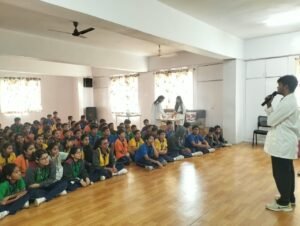
The lesson began with a classroom discussion. The teacher introduced in, on, under and near using familiar objects around the classroom.
Children observed where objects were placed and participated in simple conversations about their positions. This gave them an opportunity to hear the prepositions in context before using them themselves.
For a young learner, the difference between words such as in and on can become clearer when the child can actually see an object inside a container or placed on a surface.
The discussion therefore created the conceptual foundation for the activities that followed.
How did role play make prepositions easier to understand?
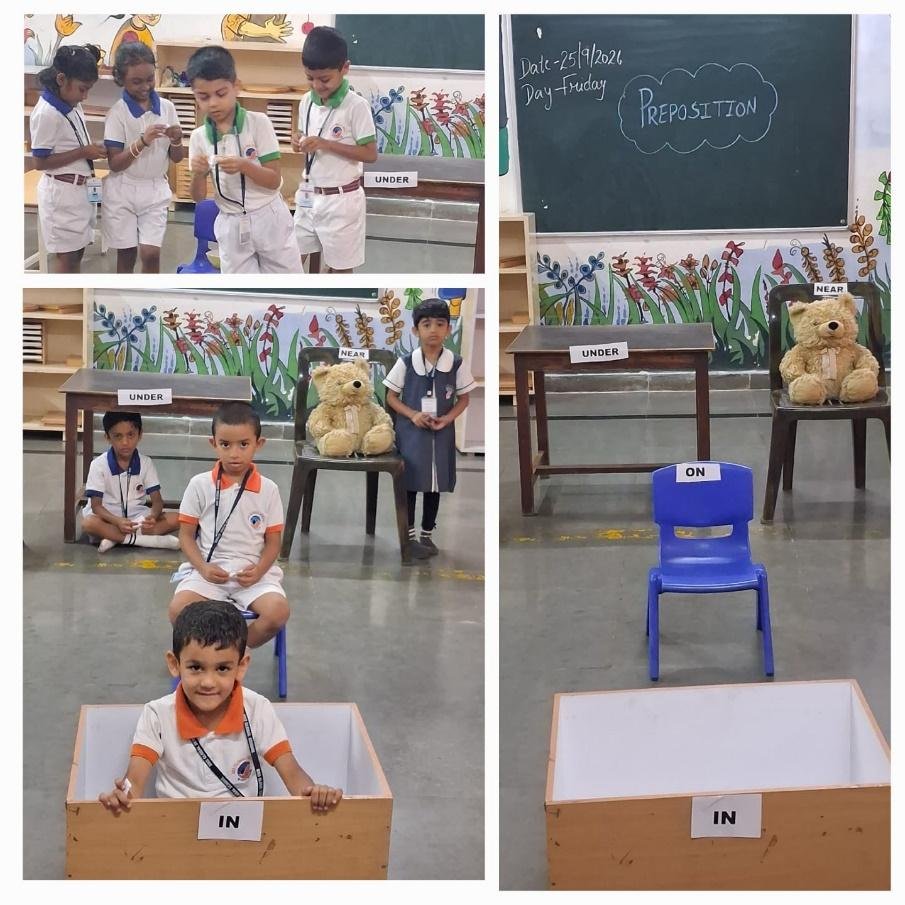
The next stage involved role play.
Children acted out different positions represented by the prepositions. By becoming part of the activity rather than remaining passive observers, they were able to connect language with physical situations.
Role play also created opportunities for children to listen carefully, respond to instructions and communicate with their peers.
The activity turned a grammar lesson into a shared classroom experience in which students could observe, participate and express their understanding.
How did physical movement support language learning?
Physical movement formed an important part of the lesson.
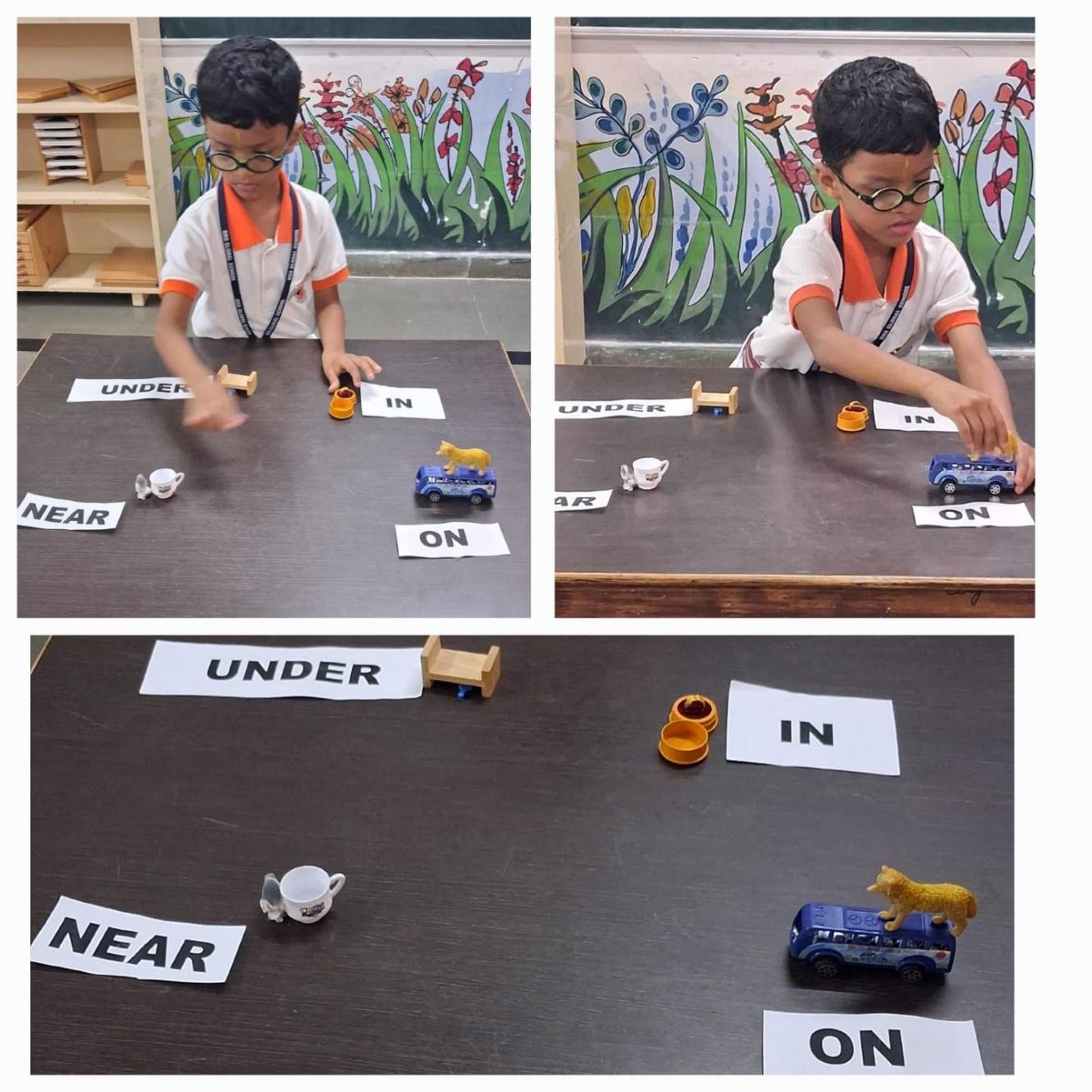
Children moved in, on, under and near different objects while following the teacher’s instructions. This hands-on component allowed them to experience positional language directly.
For example, instead of only hearing the word under, children could physically position themselves under an object or identify something that was under another object.
This connection between language and movement helped make the concept concrete and memorable.
CBSE’s competency-based learning guidance recognises experiential and active learning as effective pedagogical approaches and emphasises meaningful learning experiences that move beyond textbooks.
How did the worksheet reinforce learning?
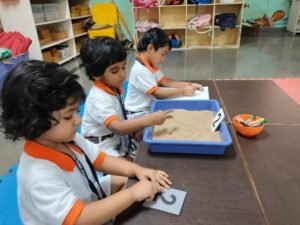
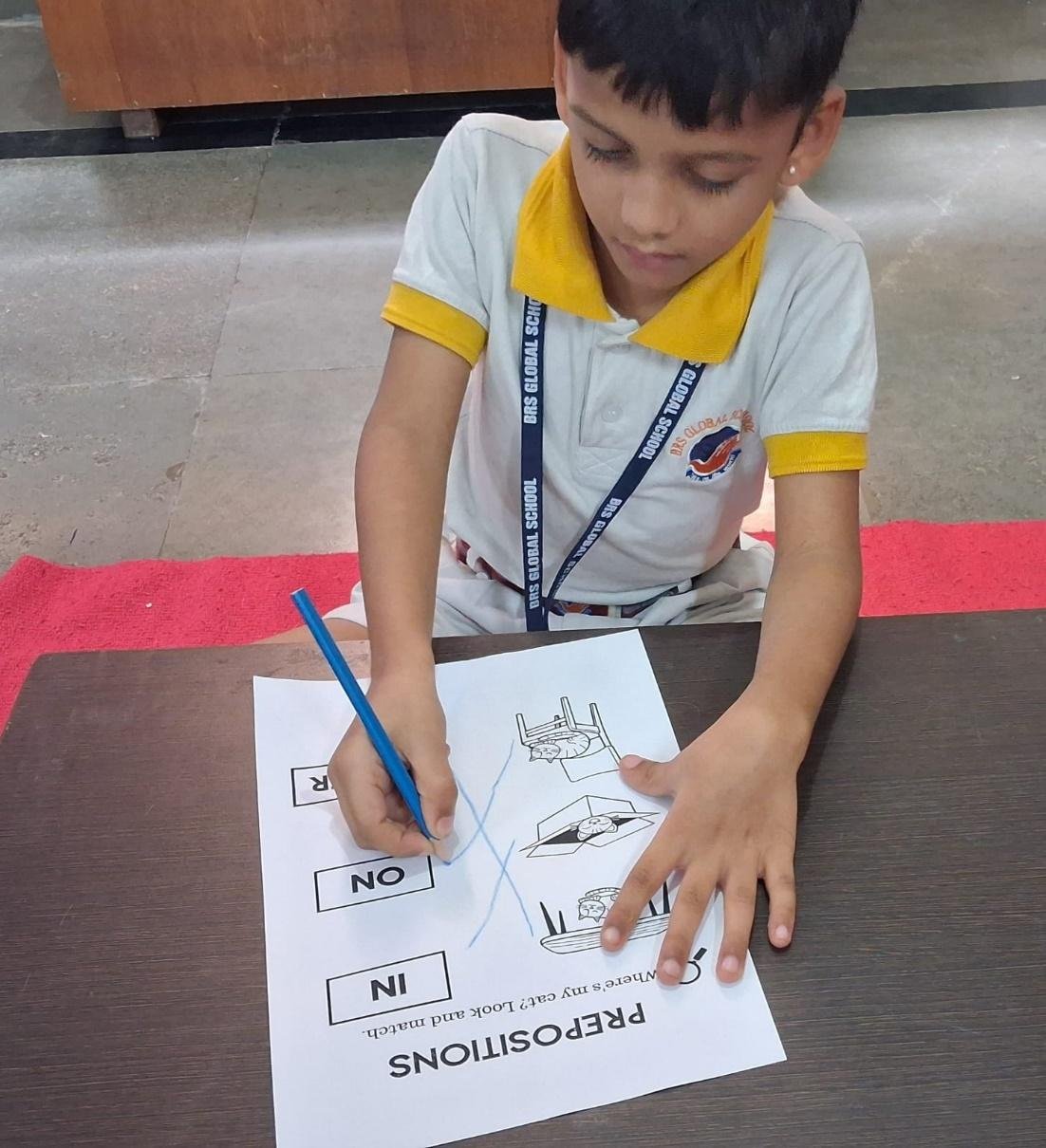
The final stage was a worksheet activity.
Students identified, matched and practised the correct prepositions through pictures and simple exercises. This gave them an opportunity to apply what they had experienced during the earlier activities.
The worksheet also served as a reinforcement activity, helping teachers observe whether students could transfer their understanding from physical experiences to visual and written tasks.
The progression was therefore:
See → Discuss → Act → Practise
This combination supported both experiential understanding and reinforcement.
Student Learning Outcomes & Benefits
What did students learn from the activity?
The immediate learning outcome was an improved understanding of the positional meanings of in, on, under and near.
However, the activity also supported several broader foundational skills.
Vocabulary development
Children heard and used new grammatical vocabulary repeatedly in meaningful situations. Repeated exposure in context can help young learners associate words with actions and objects.
Listening and comprehension
Students had to listen carefully to the teacher’s instructions and respond through movement or identification. This encouraged attentive listening and comprehension.
Speaking and communication
Classroom discussion and role play provided opportunities for children to say or respond using the target language. Such interactions can help build confidence in using English orally.
Observation skills
Students observed the position of objects and identified relationships between them. This encouraged careful visual attention.
Following instructions
Physical activities required students to understand and respond appropriately to instructions, supporting classroom readiness and self-regulation.
Participation and confidence
Because the activity involved movement, discussion and role play, children had multiple ways to participate. This can create a more inclusive classroom environment in which students are encouraged to contribute.
Conceptual understanding
The activity connected grammatical terms with actual experiences. Children were not only introduced to the words; they experienced what those words represented.
Educational Philosophy / Institutional Value Alignment
An effective early-years learning environment does not treat every concept as something that must first be memorised and later applied. Instead, children can be given opportunities to experience a concept and then express their understanding.
This prepositions activity followed that principle.
The teacher first introduced the concept, then created opportunities for students to interact with it through role play and movement, followed by worksheet-based reinforcement.
This reflects the broader CBSE emphasis on child-centric and experiential approaches. CBSE guidance describes experiential learning as an important part of competency-based learning and encourages pedagogies such as discussions, group activities, hands-on learning and other interactive methods.
For a school community, this matters because foundational learning is not only about covering a syllabus. It is also about helping children understand, communicate and apply what they learn.
Why Does This Matter for Student Development?
Why should grammar be taught through activities?
Grammar provides children with the structures they need to communicate clearly. For young learners, however, grammatical terminology can sometimes feel abstract when taught in isolation.
Activities help bridge that gap.
When a child physically experiences being under something, identifies an object on a surface or notices something near another object, the language is connected to a real experience.
This approach can make classroom learning more meaningful while also encouraging children to listen, respond, observe and participate.
How does experiential learning support holistic development?
The activity brought together cognitive, language and physical participation. Students were required to understand a concept, respond to instructions, interact with peers and complete an individual task.
Such experiences contribute to more than subject knowledge. They can support communication, confidence, attention, participation and the ability to apply learning in different contexts.
CBSE also emphasises connecting knowledge with life beyond school and encouraging students to move away from purely rote methods toward meaningful learning experiences.
Local Context Relevance
For families exploring schools in Sarjapur Road, the quality of everyday classroom experiences is an important part of understanding a school’s educational approach.
BRS Global School, Sarjapur Road serves families from Sarjapur Road and surrounding communities including Bellandur, Sarjapur Road, Hosa Road, Koramangala, HSR layout, Dommasandra, Kodathi, Gunjur, Varthur, Kaikondrahalli, Kasavanahalli, Carmelaram, Harlur, Rayasandra, Naganathapura, Doddakannelli, Kudlu Gate, A Krishnappa Nagar, Halnayakanahalli, Radha Reddy Layout, Chikkanayakanahalli, Huskur, KPC Layout, CSB Layout, Owners Court, Doddanagamangala, Doctors Layout, Shiva Reddy Layout, Meenakshi Layout, Chikbellandur, Sompura Gate, Muthannalur Cross, Gunjur to Dommasandra Road, Mullur, Amrita Engineering College Road Kasavanahalli, Amrita Nagar, Serenity Layout, Spring Fields, Iblur, Marathahalli, Shobha Apartments, Choodasandra, Junnasandra, Rayasandra.
The location is also relevant for families living near major residential communities and employment corridors around RMZ Ecoworld, Embassy TechVillage, RGA Tech Park, Prestige Tech Park and the broader Electronic City–Sarjapur Road corridor.
Parents comparing CBSE schools in Sarjapur Road, schools near Bellandur or schools serving the wider Sarjapur–HSR–Electronic City region may therefore look beyond infrastructure and academic results to understand how learning actually takes place in classrooms.
This classroom activity offers one example of that approach: a simple English concept was transformed into an interactive learning experience.
Families can explore the school’s location and profile through the BRS Global School | Best CBSE School in Sarjapur Road Google Business Profile.
Common Parent Questions
How does this activity support CBSE learning?
The activity supports an experiential, child-centred approach by allowing students to understand a language concept through discussion, role play, movement and practice. CBSE encourages experiential and active learning as part of competency-based education.
How does learning through movement help children?
Movement gives children a physical reference for abstract positional words. Experiencing in, on, under and near can help children connect language with real-world positions and situations.
Does the activity improve English communication?
It creates opportunities for students to listen to instructions, participate in discussions, respond to questions and use vocabulary in context. These experiences can support early communication development.
Why use role play for grammar?
Role play allows children to demonstrate meaning rather than only repeat definitions. It can make the learning experience interactive while encouraging participation and communication.
What skills were developed apart from grammar?
The activity supported observation, listening, comprehension, vocabulary development, following instructions, participation, communication and confidence.
Is activity-based learning useful for young children?
Yes. Young children often benefit from learning experiences that combine multiple modes such as seeing, listening, speaking, moving and practising. The activity allows a concept to be reinforced in more than one way.
Why should parents value experiential classroom activities?
Experiential activities show how a school translates curriculum concepts into meaningful classroom experiences. They give children opportunities to understand and apply ideas rather than simply memorise information.
Key Highlights of the Event
• English lesson focused on in, on, under and near
• Experiential and activity-based learning approach
• Four learning methods used in one lesson
• Classroom discussion with familiar objects
• Interactive role play
• Physical movement and teacher-led instructions
• Worksheet-based reinforcement
• Development of vocabulary and comprehension
• Opportunities for speaking and participation
• Learning through seeing, doing, speaking and practising
• Connection between classroom language and everyday situations
Frequently Asked Questions (FAQs)
What are prepositions for children?
Prepositions are words that help explain the relationship between people, objects and places. In this activity, children learned the positional prepositions in, on, under and near.
How can children learn prepositions easily?
Children can learn prepositions effectively when they encounter them in meaningful situations. Using objects, movement, pictures, role play and simple sentences can help connect the words with their meanings.
What is experiential learning in primary education?
Experiential learning is an approach in which students learn through active participation and experience. It can include activities, demonstrations, role play, hands-on tasks, observation and reflection.
Why is activity-based English learning important?
Activity-based English learning gives children opportunities to use language in context. It can strengthen vocabulary, comprehension, listening and communication while making lessons more engaging.
How does BRS Global School use experiential learning?
At BRS Global School, classroom activities can integrate discussion, participation, hands-on experiences and practice to help students connect concepts with real situations. This prepositions activity is one example of an interactive approach to foundational English learning.
Is BRS Global School located on Sarjapur Road?
Yes. BRS Global School has a Sarjapur Road campus serving families from Sarjapur Road and surrounding communities such as Kasavanahalli, Bellandur, HSR Layout, Haralur Road, Carmelaram, Dommasandra and Gunjur.
What should parents look for when choosing a CBSE school?
Parents may consider curriculum, teaching methodology, learning outcomes, teacher engagement, academic support, communication opportunities, extracurricular experiences, student wellbeing, infrastructure, accessibility and how effectively classroom learning connects with real-world experiences.
Conclusion
Learning does not always need to begin with a textbook or end with a worksheet. For young children, a concept can become much more meaningful when they are encouraged to see it, discuss it, experience it and practise it.
The prepositions activity at BRS Global School, Sarjapur Road, demonstrates how a simple English concept can become an engaging classroom experience through discussion, role play, movement and reinforcement.
Such activities support foundational language development while encouraging children to participate actively in their own learning. This approach is consistent with the broader CBSE emphasis on experiential, active and competency-oriented learning.
Are you looking for a CBSE school in Sarjapur Road where children learn through meaningful classroom experiences? Explore BRS Global School, Sarjapur Road, and discover how learning can move beyond the textbook.
Explore our Campus:
Attibele Branch:
https://share.google/iFhJaeGo8wkgOZ1Y5
Sarjapur Road Branch: