
Introduction: When Learning Becomes an Experience
At BRS Global School Attibele, Montessori education is designed to help young learners discover the world through doing, exploring, observing and experiencing. Rather than limiting learning to conventional classroom activities, children are provided with opportunities to interact with their surroundings and develop skills through meaningful experiences.
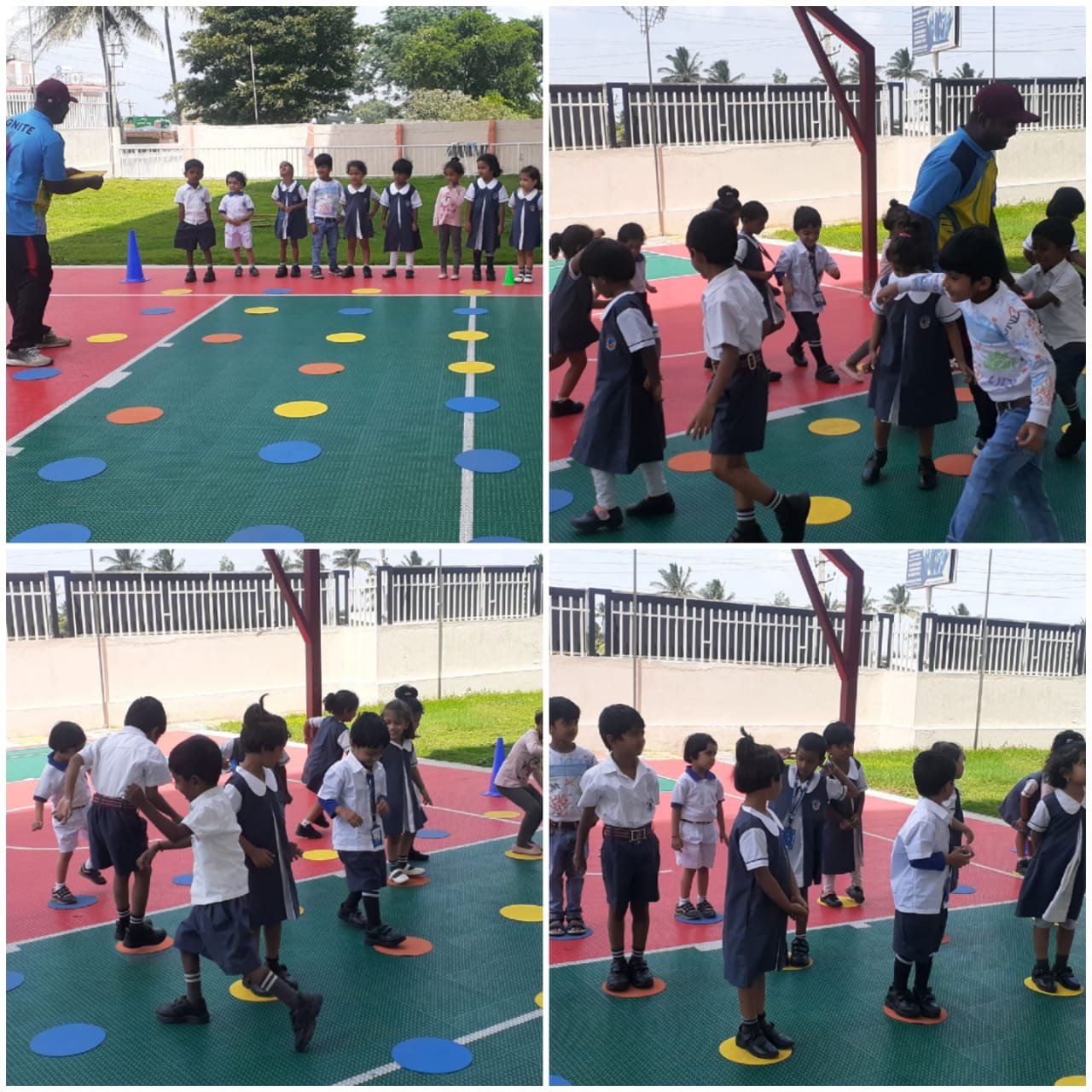
One such outdoor Montessori activity involved colourful floor markers and cones arranged to create an engaging movement space. The children stepped across the coloured markers, followed directions, moved around one another and participated enthusiastically as a group.
This simple activity became a rich learning experience, helping children develop physical, cognitive and social skills while enjoying the freedom of movement and play.
What Happened During the Montessori Activity?
The Montessori children were introduced to an outdoor activity area containing colourful circular markers and cones. The teacher guided the children as they moved along the designated path and responded to different instructions.
The children had to observe the markers, decide where to step, maintain their balance and move carefully through the activity area. They also interacted with their classmates, waited for their turns and observed how others participated.
The activity therefore combined several learning experiences:
• Movement and physical coordination
• Colour identification
• Listening and responding
• Balance and body control
• Observation and concentration
• Group participation
• Turn-taking and cooperation
• Independent movement
The colourful environment made the activity particularly engaging for young learners and transformed the outdoor space into an experiential learning area.
How Do Montessori Children Learn Through Movement?
Montessori children learn through movement by using their bodies, senses and surroundings to understand concepts through direct experience.
As the children stepped from one coloured marker to another, they were not simply exercising. They were developing gross motor coordination, balance, body awareness and spatial understanding.
They had to control their movements, judge distances and place their feet carefully. Such experiences help young children become more aware of how their bodies move in relation to objects and people around them.
At BRS Global School Attibele, this approach reflects the school’s emphasis on experiential learning, where children are encouraged to explore concepts actively rather than simply memorising information.
How Does the Activity Help Children Learn Colours?
The activity makes colour learning experiential by allowing children to identify and respond to different coloured markers while moving through the activity space.
Instead of learning colours only through worksheets, children encountered colours in a physical environment. They observed the different markers and associated visual recognition with movement and instructions.
This helped strengthen:
• Colour recognition
• Visual discrimination
• Observation
• Attention
• Memory and response
This type of activity makes early learning more interactive because children can see, move, respond and experience rather than simply repeat information.
What Happens When Children Learn Through Play?
Play-based learning allows children to develop important skills naturally while they are engaged in an enjoyable activity.
During the Montessori activity, children were actively moving and participating without experiencing the activity as a conventional lesson. They were learning through play while simultaneously developing physical, cognitive and social abilities.
This approach helps make learning:
• Enjoyable
• Meaningful
• Interactive
• Experiential
• Child-centred
At BRS Global School | Pre-school, Primary School & High School | Attibele, activities such as these provide young learners with opportunities to connect learning with real experiences.
How Does the Activity Develop Independence and Confidence?
The children were encouraged to participate in the movement activity independently. As they successfully completed each movement, they gained confidence in their own ability to follow instructions and complete a task.
Small achievements such as stepping accurately on a marker, maintaining balance or completing a movement sequence can encourage children to become more willing to try new activities.
The experience therefore supported:
• Independence
• Self-confidence
• Positive attitudes towards learning
• Willingness to participate
• Controlled decision-making
These are valuable foundations for children’s continuing educational journey.
How Does Montessori Learning Encourage Social Skills?
The activity was also a group learning experience. Children participated alongside their classmates, observed one another, waited for turns and cooperated within the activity area.
These interactions provided opportunities to practise:
Turn-taking → Cooperation → Patience → Observation → Teamwork → Respect for others
Such experiences demonstrate that early childhood learning is not limited to academic concepts. Children are also developing the social behaviours and communication skills they need to participate confidently in a learning community.
What Skills Were Developed Through the Montessori Activity?
The activity supported a wide range of developmental skills:
| Skill | How the Activity Supported It |
|---|---|
| Gross motor skills | Walking, stepping and controlled movement |
| Balance | Maintaining body stability while stepping |
| Body coordination | Coordinating feet, hands and body movements |
| Colour recognition | Identifying different coloured markers |
| Observation | Watching markers, pathways and classmates |
| Concentration | Paying attention to instructions |
| Listening | Responding to teacher directions |
| Spatial awareness | Understanding positions, distance and movement |
| Social skills | Participating with peers |
| Teamwork | Cooperating during group activities |
| Confidence | Completing movements independently |
| Agility | Changing direction and controlling movement |
These skills are consistent with the activity outcomes documented in the school’s event report.
Why Does Activity-Based Learning Matter for Student Development?
Activity-based learning gives young children opportunities to develop multiple skills simultaneously through meaningful experiences.
A single Montessori activity can involve physical movement, sensory observation, language through instructions, social interaction and independent decision-making.
At BRS Global School Attibele, the Montessori approach focuses on hands-on experiences that engage children’s senses, encourage curiosity and support independence. Activities may include movement, art, sensory exploration, practical life experiences and outdoor learning.
This creates a learning environment where children are encouraged not merely to know something, but to experience it and understand it through action.
How Does This Support Holistic Learning?
Holistic development means supporting the child across different areas rather than focusing only on academic performance.
This Montessori activity brought together:
• Physical development through movement and coordination
• Cognitive development through observation and colour recognition
• Social development through group participation
• Emotional development through confidence-building experiences
• Independence through individual participation
• Communication and listening through teacher instructions
This integrated approach is particularly valuable during the early years, when children are developing foundational habits, skills and attitudes towards learning.
How Does This Activity Support CBSE-Oriented Learning?
Although the activity is designed for Montessori learners, its emphasis on experiential learning, observation, participation, communication, physical development and skill-building complements the broader learning approach expected in contemporary school education.
The children were actively engaged rather than passively receiving information. They observed, listened, moved, responded and interacted – making the experience purposeful and learner-centred.
For parents looking at CBSE schools in Attibele, such experiences can be an important indicator of how a school approaches the development of the whole child.
Why Should Parents Value Activity-Based Montessori Learning?
Parents often look for an early learning environment where children can develop confidence alongside foundational academic readiness.
Activity-based Montessori experiences provide opportunities for children to:
• Learn through direct experience.
• Develop physical coordination.
• Strengthen concentration.
• Become more independent.
• Build confidence.
• Interact positively with peers.
• Develop curiosity and observation.
• Enjoy learning in a natural environment.
At BRS Global School Attibele, the objective is to create opportunities where every experience becomes an opportunity to learn.
BRS Global School Attibele: Learning Beyond the Classroom
BRS Global School | Pre-school, Primary School & High School | Attibele offers a premium CBSE learning environment that combines academic learning with holistic development, experiential learning, sports, arts, life skills, leadership opportunities and confidence-building programmes.
The Attibele campus is strategically located along the Attibele–Sarjapur Road corridor, making it accessible to families from Attibele, Bidaraguppe, Anekal, Chandapura, Sarjapur, Sarjapura and surrounding communities. It also provides connectivity towards Hosur Road, Electronic City, Bommasandra, Sompura, Jigani and other growing residential and industrial areas of South-East Bengaluru.
For parents searching for schools in Attibele, CBSE schools in Attibele, schools in Anekal, schools in Chandapura, schools in Sarjapur Road or schools near Sarjapur Road, the location of BRS Global School Attibele makes it a relevant option to explore.
Local Learning for Growing Communities
The Attibele–Sarjapur educational corridor serves families from a wide range of residential and professional communities. The school’s local accessibility is relevant to families living in and around:
Attibele | Bidaraguppe | Sarjapur Road | Sarjapura | Anekal | Chandapura | Dommasandra | Jigani | Bommasandra | Electronic City | Sompura | Hosur Road | Hosur Toll | Marasuru | Mukandapalli | Govinda Agrahara
The campus is also positioned near major employment and residential areas, including the Attibele and Bommasandra industrial areas, Jigani Industrial Estate, Electronic City and the Hosur industrial corridor.
For families comparing schools in Attibele and neighbouring South-East Bengaluru communities, local accessibility combined with a holistic learning environment can be an important consideration.
What About the BRS Global School Sarjapur Road Branch?
BRS Global School also has another branch on Sarjapur Road, serving families from areas including Bellandur, HSR Layout, Harlur, Dommasandra, Kodathi, Gunjur, Varthur, Kaikondrahalli, Kasavanahalli, Carmelaram, Rayasandra, Naganathapura, Doddakannelli, Kudlu Gate and several surrounding communities.
For this article, however, the featured campus is specifically the BRS Global School Attibele branch.
Common Parent Questions
How does Montessori activity-based learning benefit young children?
Montessori activities give children opportunities to learn through direct interaction, movement, observation and exploration. This can support physical coordination, concentration, independence, confidence, social interaction and curiosity.
What did the children learn from the colour activity?
The children developed colour recognition, observation, balance, coordination, concentration, spatial awareness and listening skills while following the activity path.
Is learning through play useful for early childhood education?
Yes. Play provides young children with a natural environment for exploration and participation. When thoughtfully designed, play-based activities can combine physical, cognitive and social learning.
Does Montessori learning focus only on academic concepts?
No. The activity described in this report demonstrates a broader approach involving movement, sensory observation, independence, social interaction and confidence-building alongside early learning.
How does the activity help children become independent?
Children were encouraged to complete movements themselves. Successfully following the activity helped them gain confidence and develop a willingness to participate independently.
Which children benefit from these activities?
Young learners benefit particularly from activities that combine movement, observation, sensory experiences and social interaction. Such experiences can support different aspects of early childhood development simultaneously.
Why are hands-on activities important at BRS Global School Attibele?
Hands-on activities provide children with opportunities to experience concepts rather than simply memorise them. At BRS Global School Attibele, experiential learning is part of the school’s broader emphasis on holistic student development.
Key Highlights
• Colourful outdoor Montessori movement activity
• Hands-on experiential learning
• Colour recognition through activity
• Gross motor development
• Balance and body coordination
• Listening and following instructions
• Concentration and observation
• Spatial awareness
• Social interaction and teamwork
• Confidence and independence
• Learning through play and exploration
Frequently Asked Questions (FAQs)
What Montessori activities are conducted at BRS Global School Attibele?
Montessori learning at BRS Global School Attibele includes opportunities for hands-on experiences such as movement, sensory exploration, practical life activities, art and outdoor learning.
How does outdoor activity support Montessori education?
Outdoor activities give children opportunities to use movement, observation and sensory exploration while developing coordination, confidence and awareness of their surroundings.
What skills do Montessori children develop through movement activities?
Movement activities can support gross motor skills, balance, agility, body coordination, spatial awareness, concentration and controlled movement.
Why is colour recognition important in early learning?
Colour recognition supports children’s ability to visually distinguish and identify objects. Combining colour recognition with movement makes the learning experience interactive and memorable.
How does BRS Global School Attibele encourage experiential learning?
The school provides opportunities for children to learn by doing, exploring, observing and experiencing, helping connect learning with practical experiences.
Is BRS Global School Attibele accessible from Sarjapur Road and Anekal?
The Attibele campus is located along the Attibele–Sarjapur Road corridor and is positioned for access from Attibele, Anekal, Sarjapur, Sarjapura, Chandapura and surrounding communities.
Does BRS Global School have another branch?
Yes. BRS Global School also has another branch on Sarjapur Road, serving families in and around Sarjapur Road, Bellandur, HSR Layout, Harlur, Dommasandra and other nearby communities.
Conclusion: Little Hands, Big Learning
At BRS Global School Attibele, Montessori learning is built around the belief that children learn best when they are given meaningful opportunities to explore, discover and do.
The colourful movement activity demonstrated how a simple outdoor experience can become a powerful learning opportunity. From colour recognition and balance to concentration, teamwork and independence, the children developed multiple skills while enjoying the process.
For parents exploring CBSE schools in Attibele and the wider Attibele–Sarjapur Road corridor, the school’s emphasis on experiential learning and holistic development offers an approach where children’s early educational experiences are designed to be active, engaging and purposeful.
At BRS Global School Attibele, every activity can become a learning opportunity—and every little step can be a step towards confident, independent learning.
Explore Our Campus:
Attibele Campus Google Business Profile: https://share.google/iFhJaeGo8wkgOZ1Y5
Sarjapur Road Campus Google Business Profile: https://share.google/2oEno2EtFtY7eyP2B