Introduction: Exploring India's Diversity Through Art Integrated Learning
Understanding a country as diverse as India involves more than reading about its states, languages and traditions in textbooks. Children develop a deeper appreciation of their surroundings when they explore different cultures, observe geographical differences and connect classroom concepts with real-life examples.
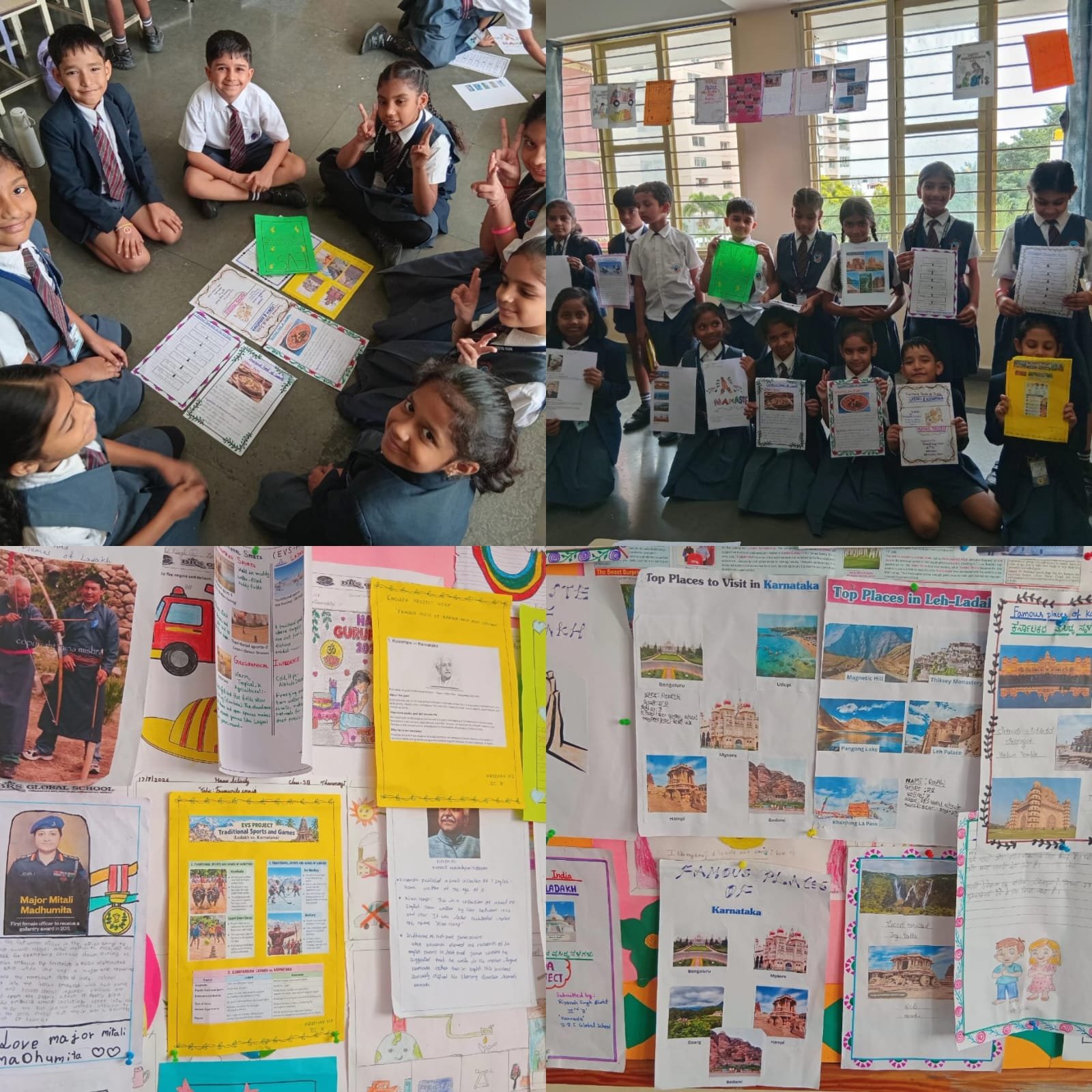
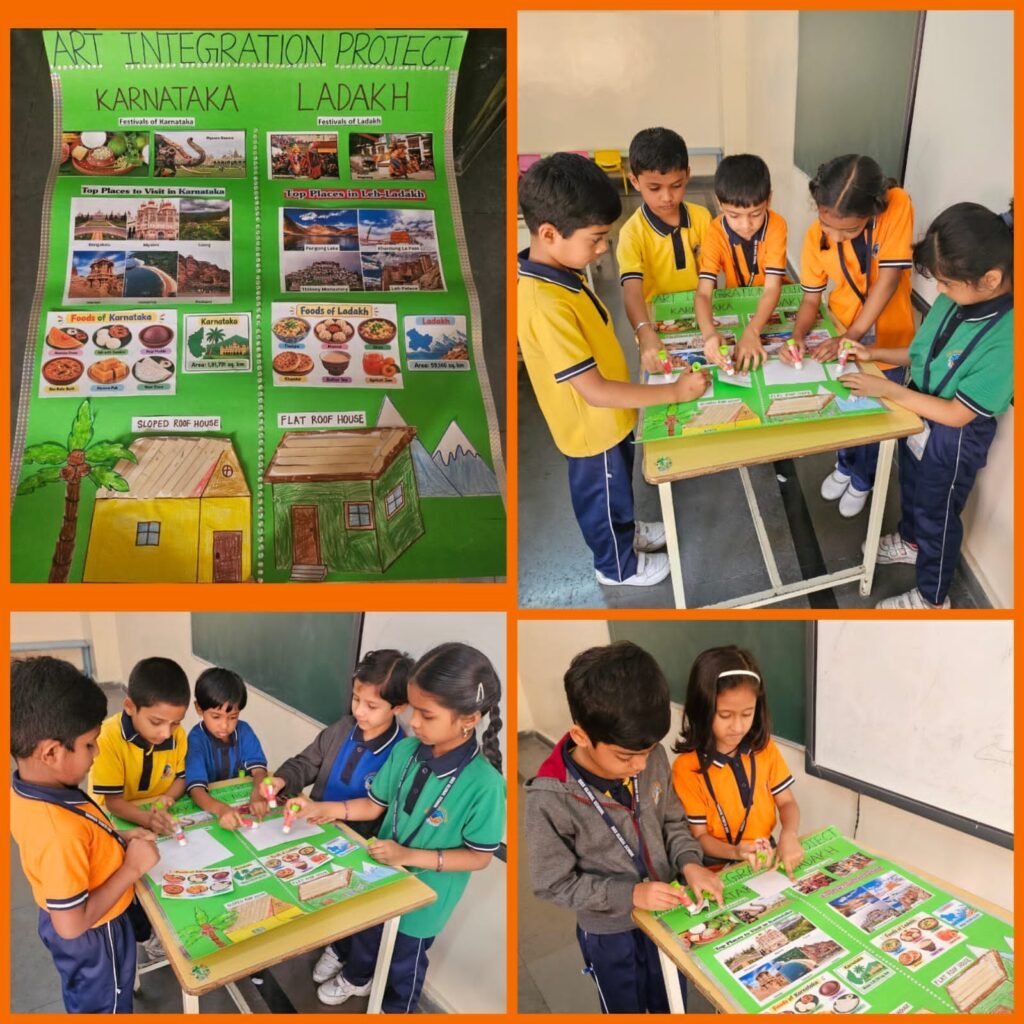
At BRS Global School, Sarjapur Road, Kasavanahalli, students from Grades 1 to 4 participated in an Art Integrated Learning and Project Work activity based on two culturally and geographically distinct regions of India: Karnataka and Ladakh.
The project brought together multiple subjects, including English, Hindi, Kannada, Mathematics and Environmental Studies. Through drawings, postcards, traditional patterns, food-related activities, research and creative project work, students explored how people in different regions live, communicate, celebrate festivals and adapt to their environments.
Rather than approaching each subject independently, the activities encouraged students to make connections between what they learn in the classroom and the world around them.
This approach also introduced children to an important national concept: Unity in Diversity – different cultures, languages and traditions coming together as one India.
Event Overview: Art Integrated Learning – Karnataka and Ladakh
Art Integrated Learning is an educational approach that uses artistic and creative activities to help students understand concepts across different subjects.
The Karnataka–Ladakh project gave students opportunities to explore regional diversity through age-appropriate, subject-based activities.
Event : Art Integrated Learning & Project Work
Theme : Karnataka – Ladakh
Institution : BRS Global School
Campus : Sarjapur Road, Kasavanahalli
Classes : Grades 1–4
Subjects Integrated : English, Hindi, Kannada, Mathematics and EVS
Learning Approach : Interdisciplinary and creative project-based learning
Central Theme : India’s Unity in Diversity
Each grade explored the theme through different activities suited to its learning level.
The project encouraged children to observe, investigate, compare, create and communicate their understanding rather than simply memorising information.
What Happened During the Art Integrated Learning Activity?
The project was organised grade-wise, with each class exploring different aspects of Karnataka and Ladakh.
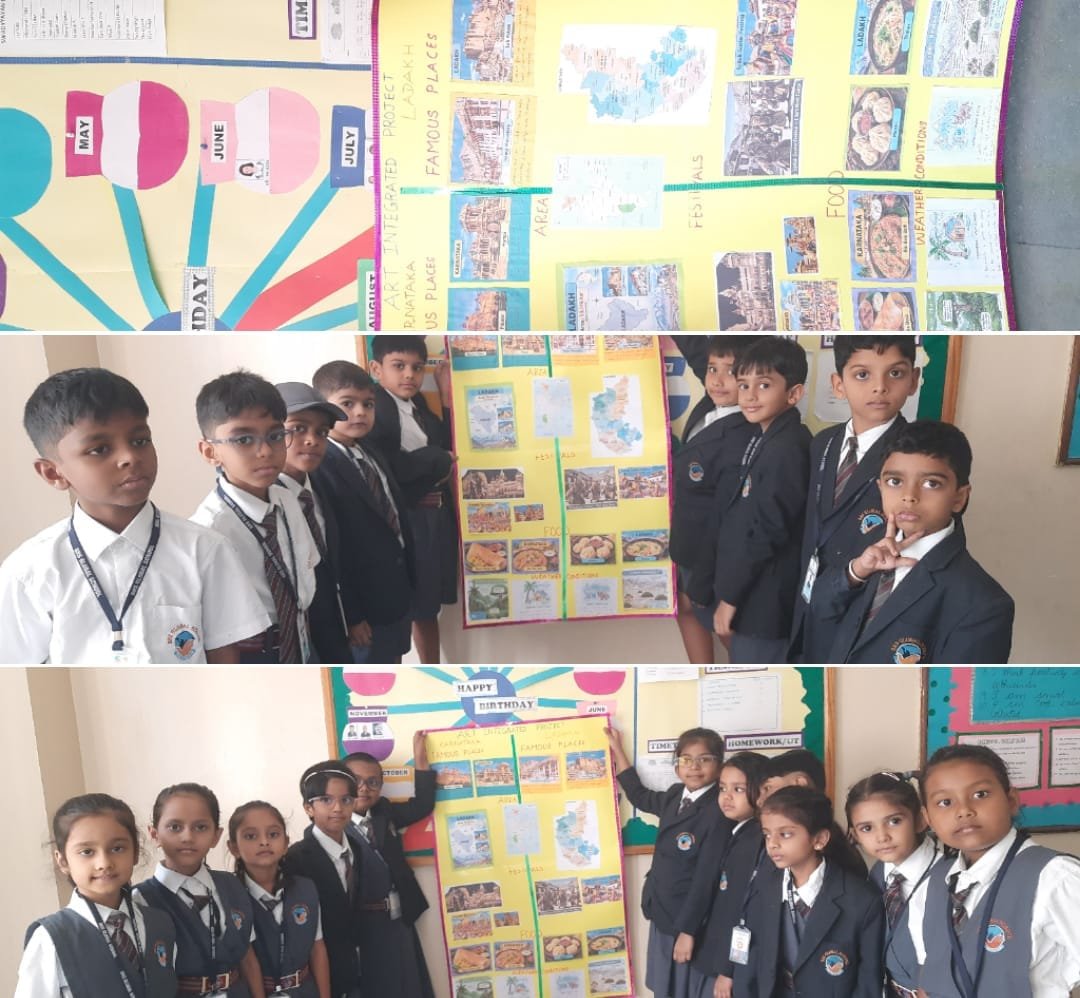
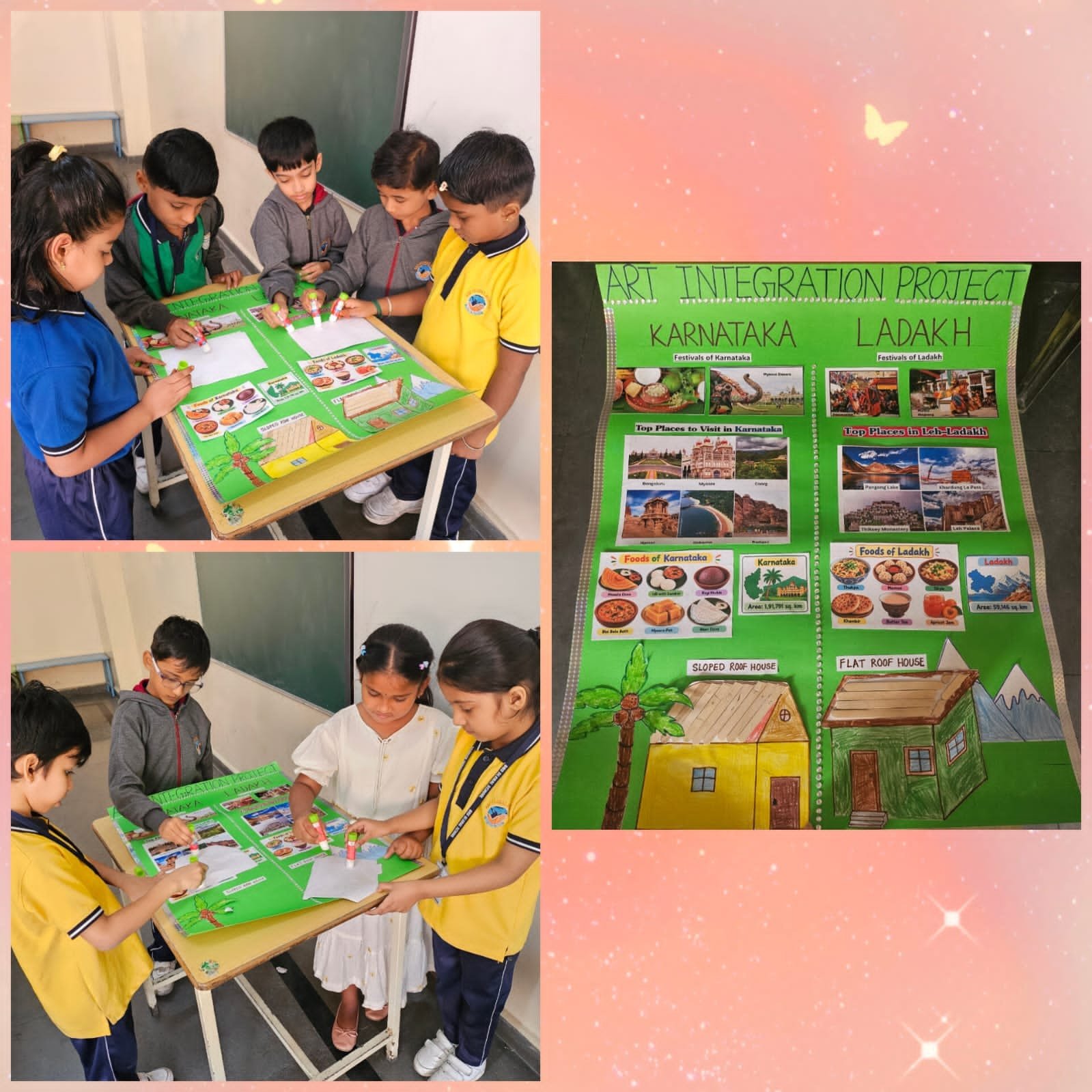
Grade 1: Exploring Karnataka and Ladakh
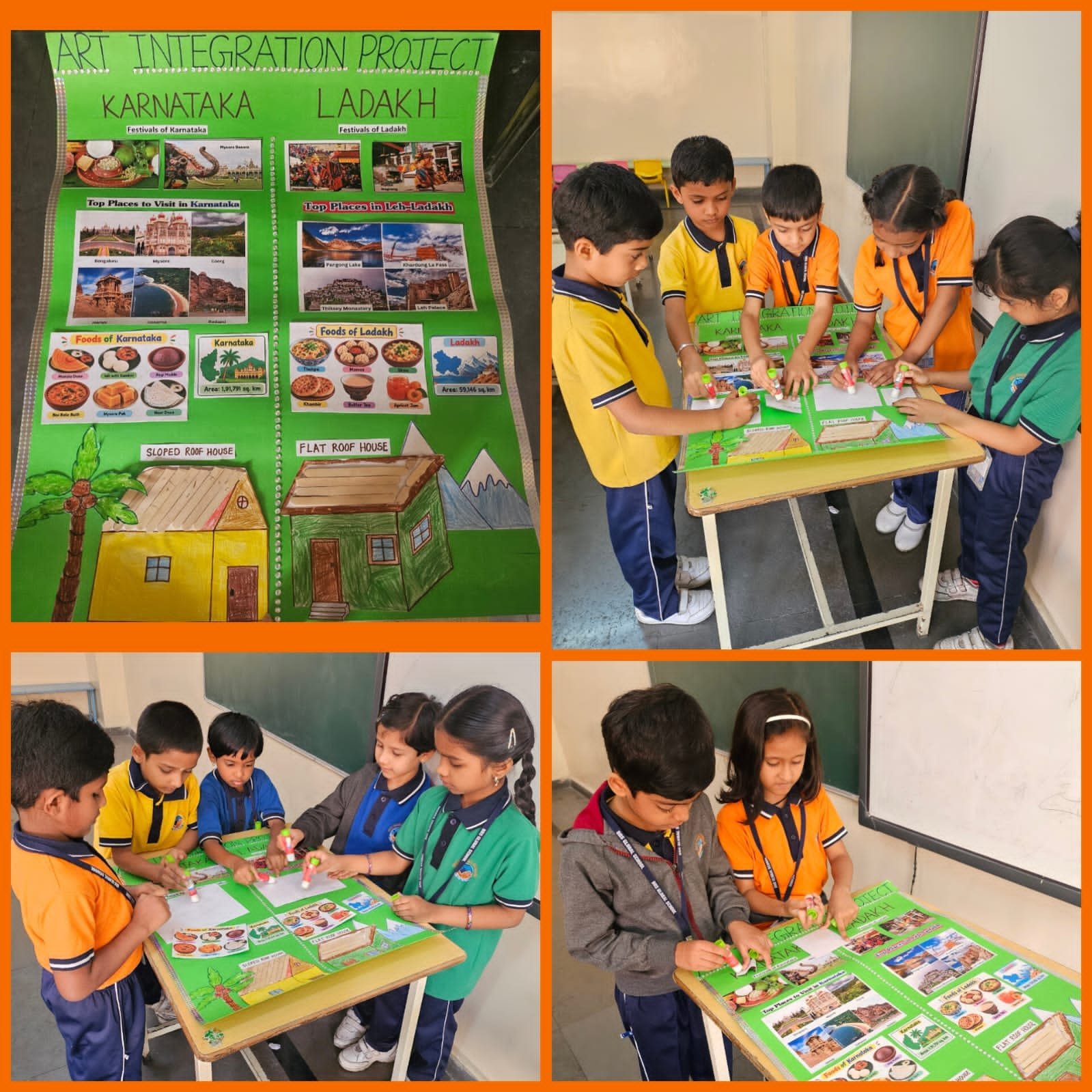
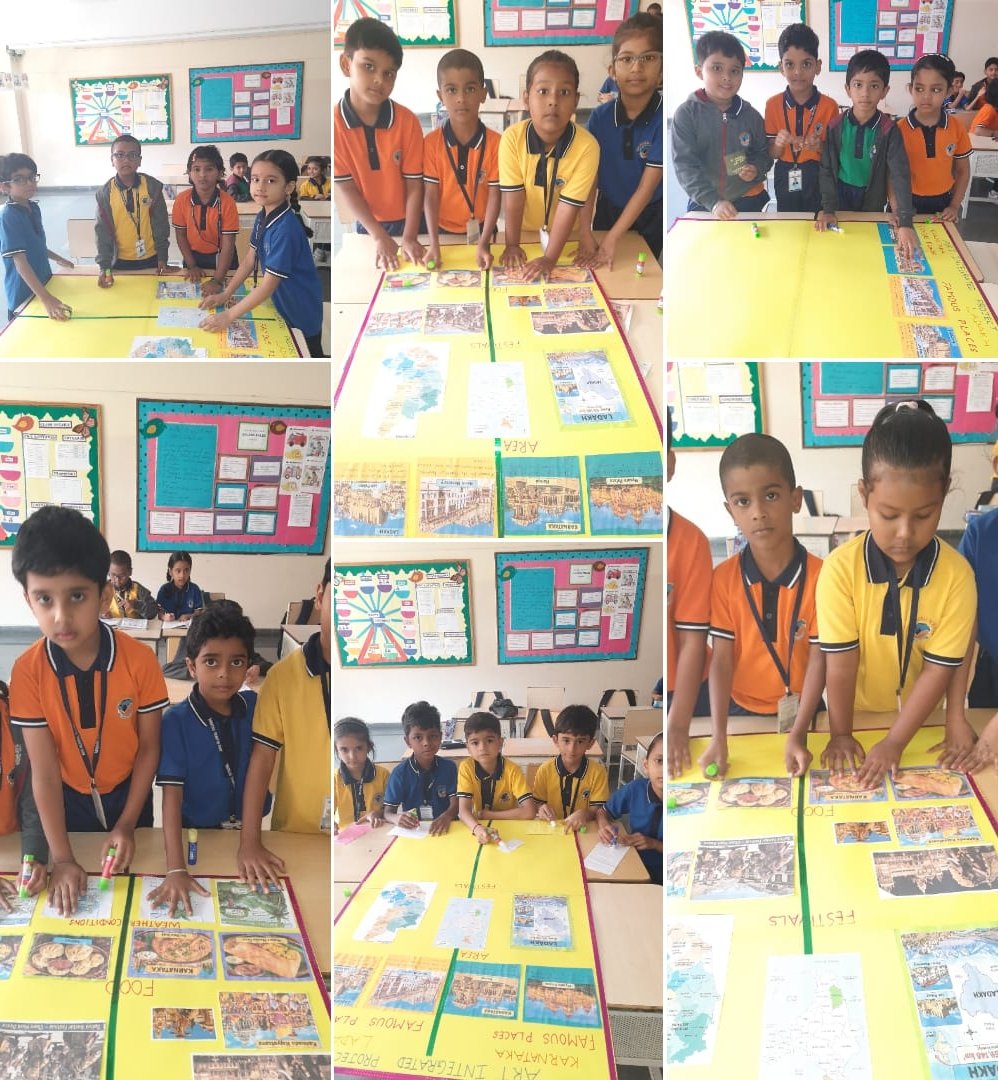
Grade 1 students began their exploration by learning about famous places, regional weather, festivals, geographical areas and traditional food.
Their activities included:
• English: Collecting pictures of famous places in Karnataka and Ladakh.
• Hindi: Exploring weather conditions and the environment.
• Kannada: Learning about festivals celebrated in both regions.
• Mathematics: Representing and exploring the areas of the regions through project activities.
• EVS: Identifying traditional foods associated with Karnataka and Ladakh.
Students used drawings and pictures to represent their observations. They illustrated a coconut tree and a sloping-roof house to represent Karnataka, while snowy mountains and a flat-roof house represented Ladakh.
These visual activities helped young learners understand that geographical conditions influence the way people live, the food they eat and the houses they build.
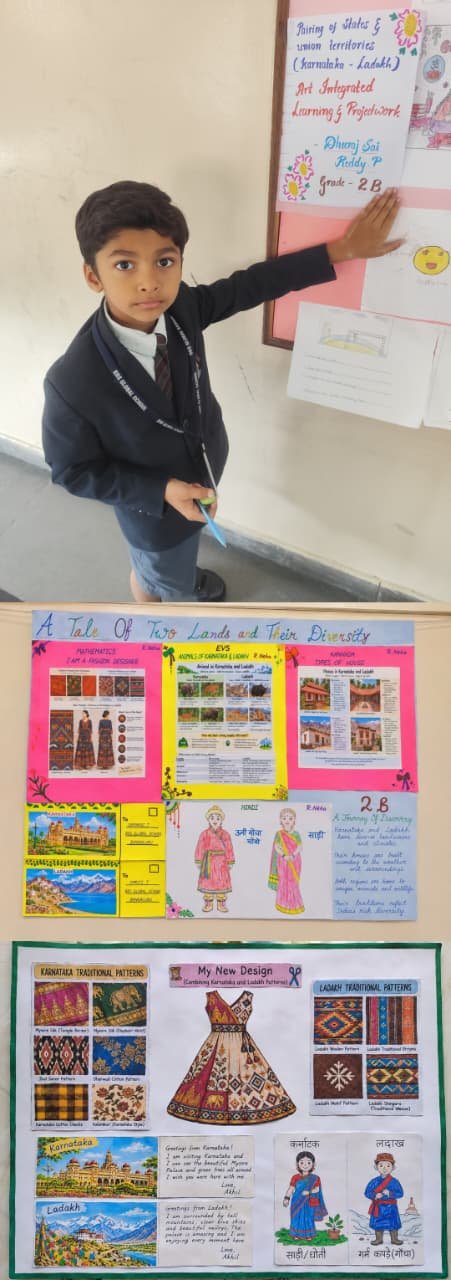
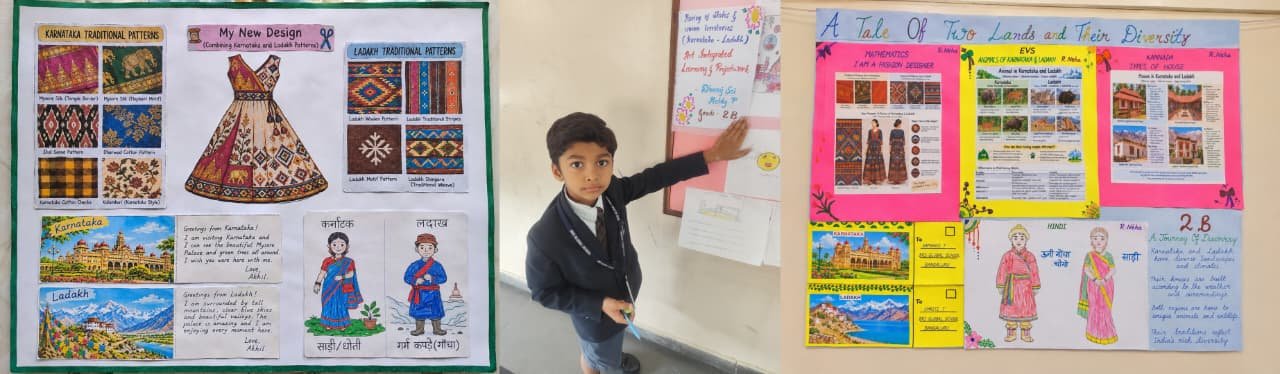
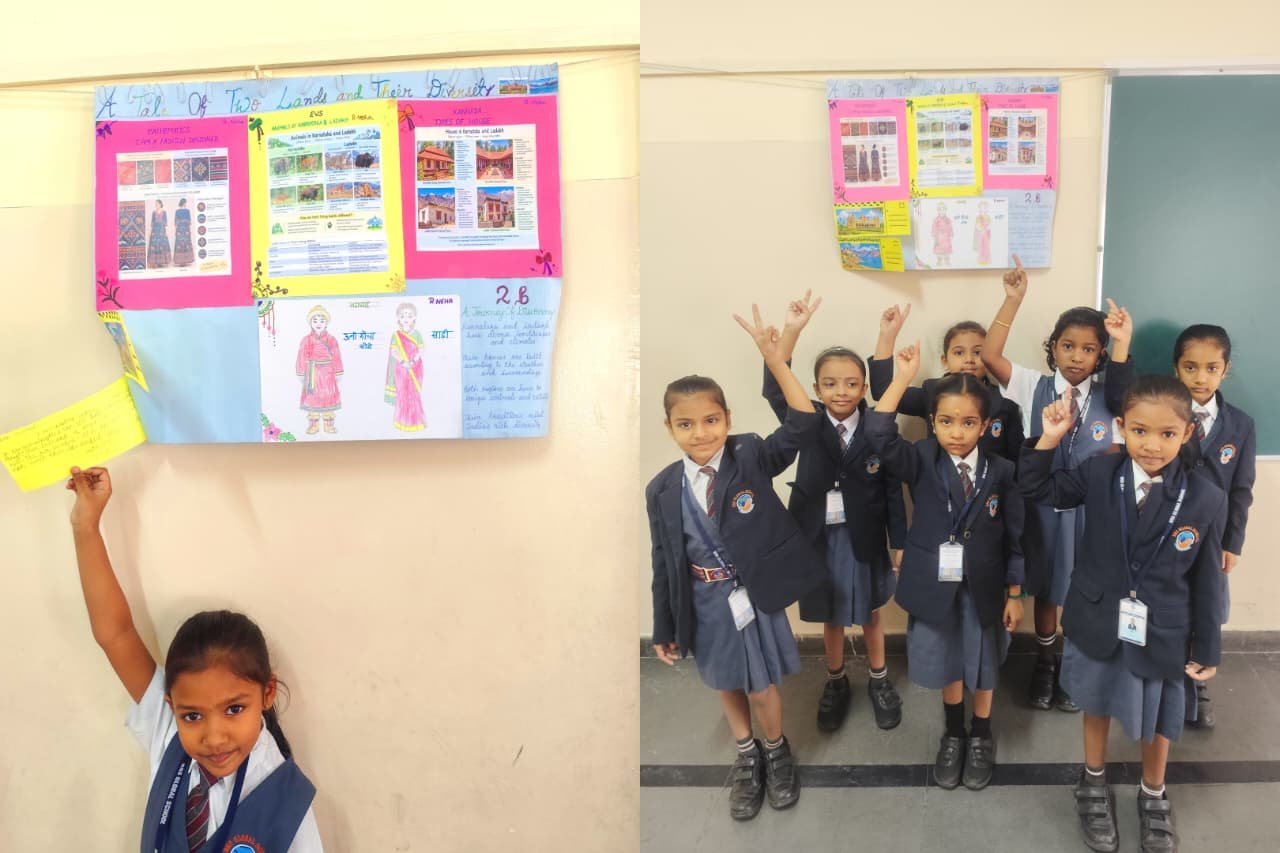
Grade 2: A Postcard from Karnataka and Ladakh
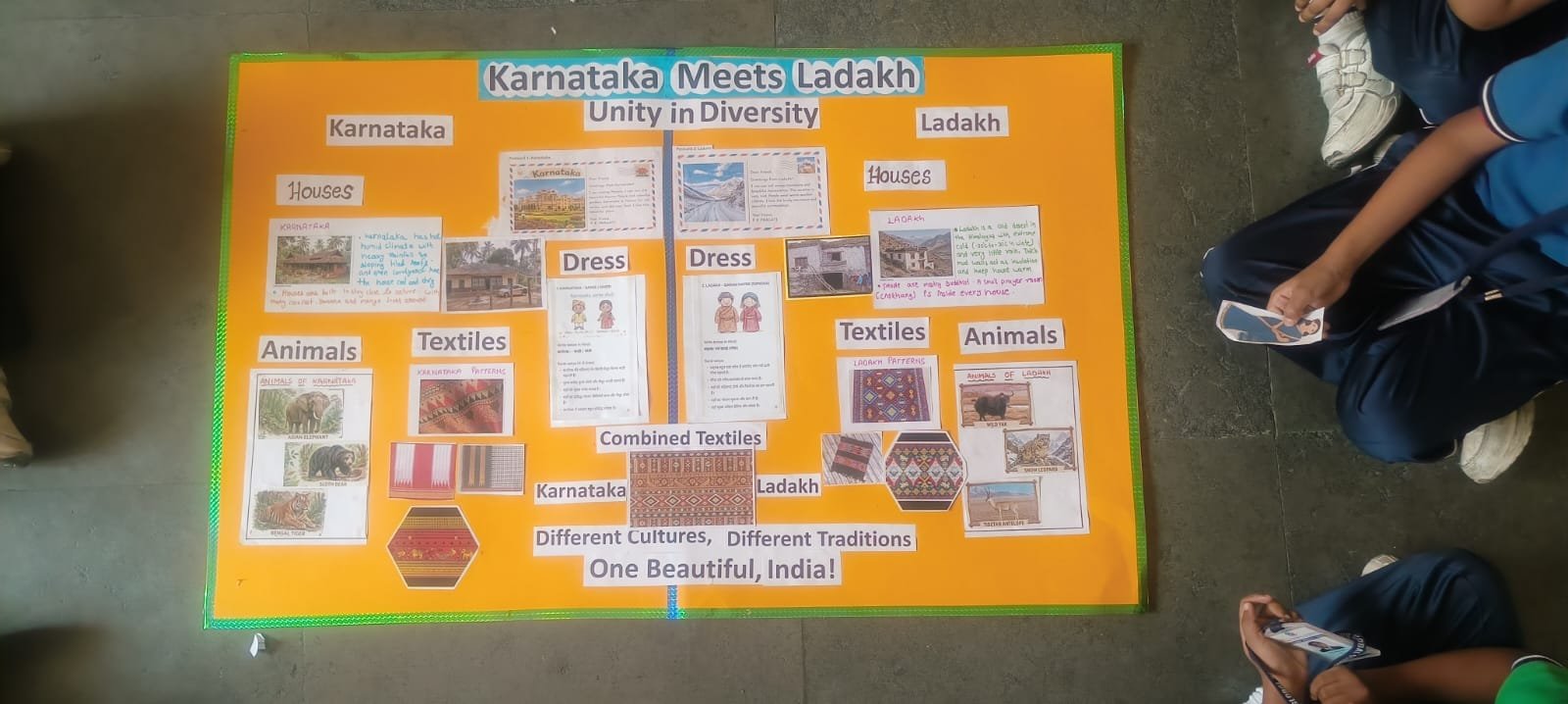
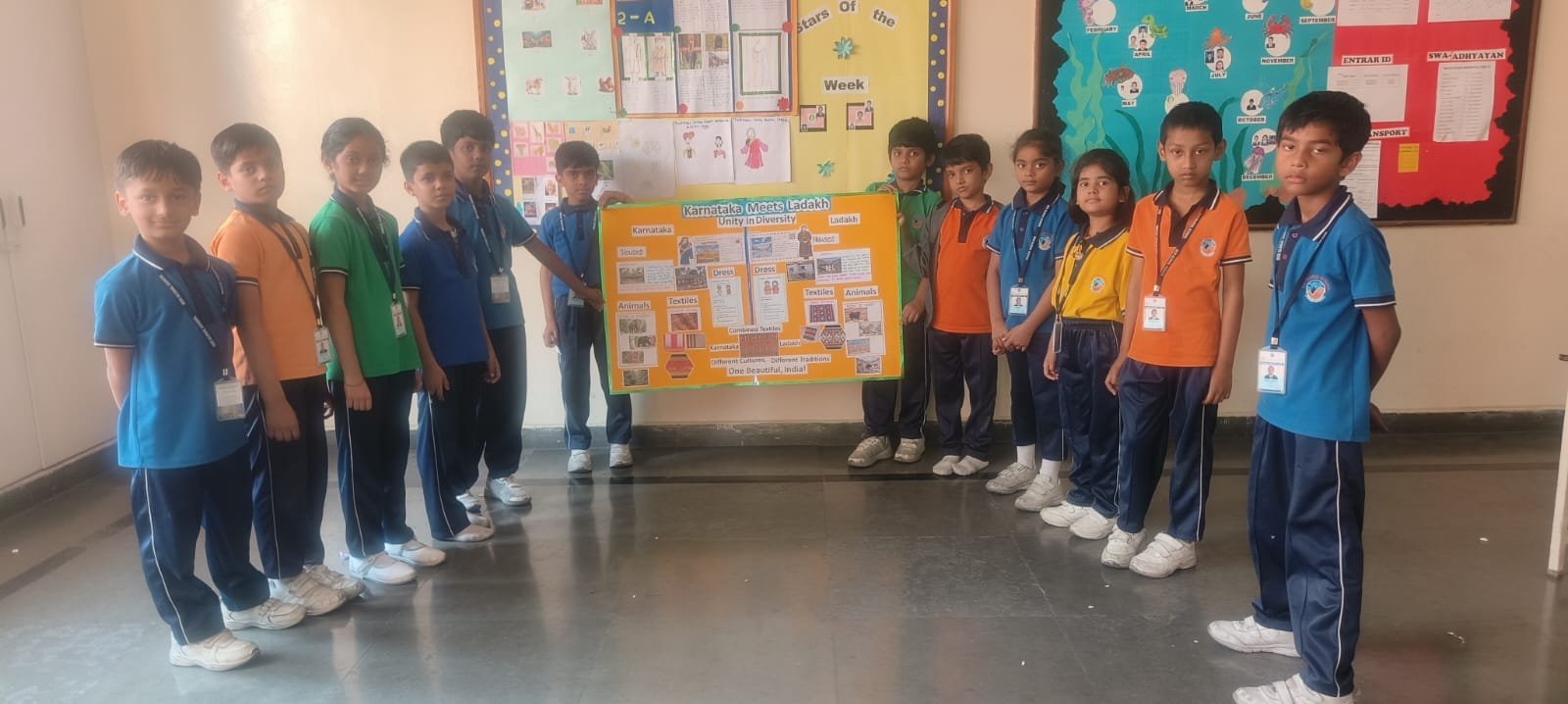
Grade 2 students explored regional culture through postcard creation, traditional clothing, house designs, textile patterns and animals.
Their activities included:
• English: Creating postcards to describe places and share information.
• Hindi: Exploring traditional dresses.
• Kannada: Learning about different types of houses.
• Mathematics: Studying traditional patterns and applying pattern-making concepts to fashion design.
• EVS: Identifying animals found in Karnataka and Ladakh.
Students created postcards, explored traditional clothing and houses, and combined textile patterns to design new outfits.
They also compared animals from both regions and learnt how climate and natural surroundings influence clothing choices and animal habitats.
The postcard activity introduced children to a simple but meaningful form of written communication. The creative design activities encouraged them to identify patterns, use their imagination and express ideas visually.
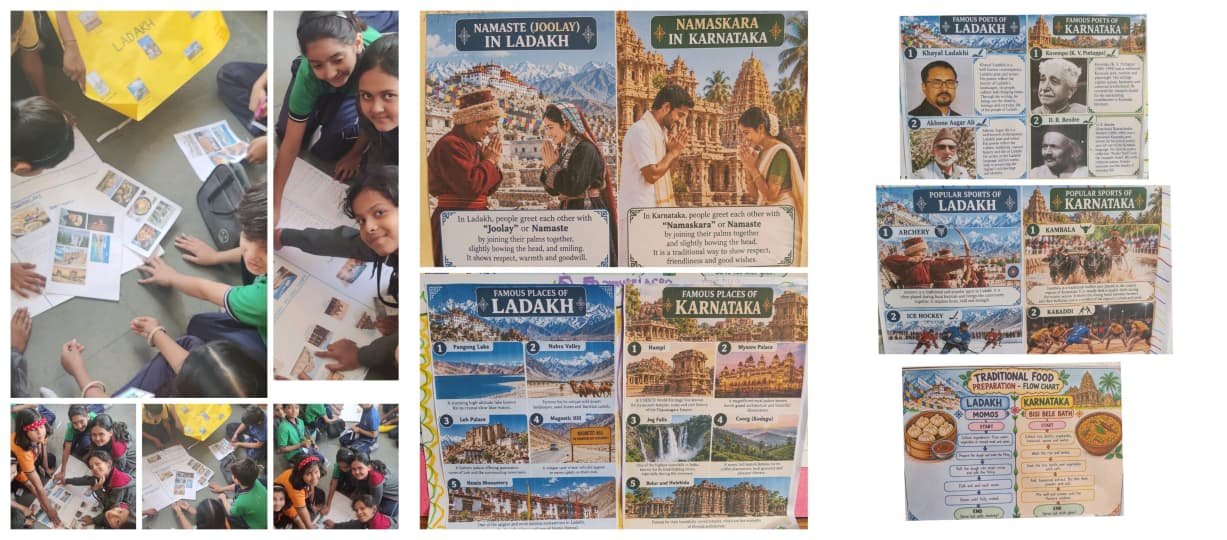
Grade 3: Discovering Karnataka and Ladakh
Grade 3 students explored the literary, linguistic, cultural and recreational traditions of Karnataka and Ladakh.
Their activities included:
• English: Learning about famous poets and their contributions.
• Hindi: Exploring greetings and expressions used in different regions.
• Kannada: Identifying famous places in Karnataka and Ladakh.
• Mathematics: Exploring traditional food preparation through flowcharts and measurements.
• EVS: Learning about traditional sports and games.
Students discovered poets from both regions and learnt about their contributions to literature.
They also explored regional greetings such as Namaskara from Karnataka and Joolay from Ladakh.
An interesting part of the project was the exploration of traditional games. Students learnt about Kambala and Lagori in Karnataka, along with ice hockey and archery in Ladakh.
Food-related activities introduced them to preparation sequences and measurements through flowcharts. This helped connect mathematical thinking with familiar everyday activities.
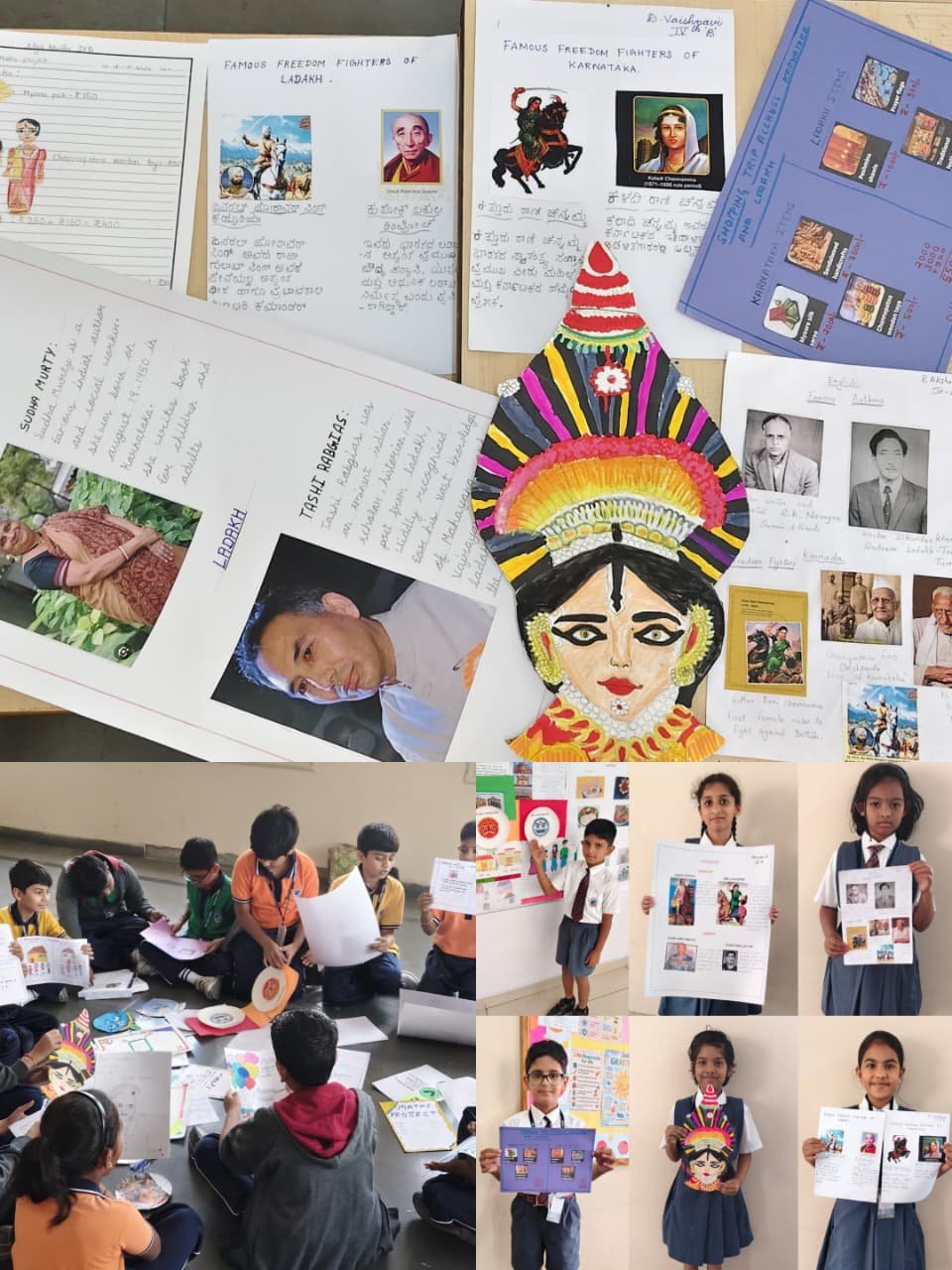
Grade 4: Learning Across Regions
Grade 4 students explored Karnataka and Ladakh through literature, language, history, mathematics and creative design.
Their activities included:
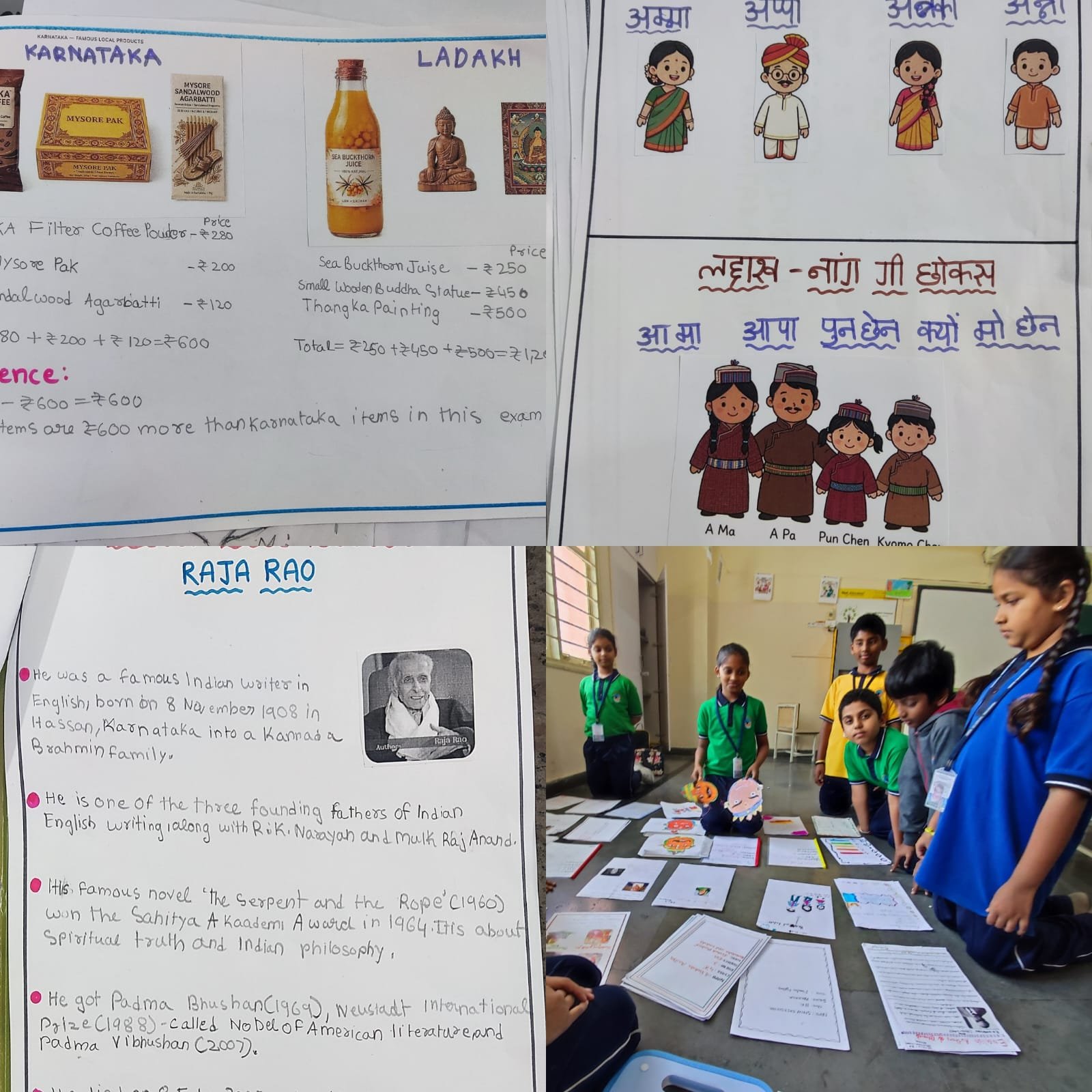
• English: Researching famous English authors.
• Hindi: Learning vocabulary related to family members.
• Kannada: Exploring freedom fighters.
• Mathematics: Planning a shopping trip using prices, calculations and totals.
• EVS: Designing festival masks inspired by regional celebrations.
Students researched writers and freedom fighters, compared family-related words and explored the cultural contributions of different regions.
The shopping activity introduced practical mathematical applications. Students prepared shopping lists, worked with prices, calculated totals and compared costs using the Indian rupee symbol.
For EVS, they designed festival masks inspired by Karnataka and Ladakh, combining creativity with cultural understanding.
Student Learning Outcomes and Educational Benefits
The Karnataka–Ladakh project provided students with opportunities to learn through different forms of expression and subject integration.
Some of the important learning outcomes included:
Cultural awareness
Students discovered different languages, festivals, traditional clothing, food habits, houses and recreational activities. This helped them appreciate the cultural richness of India.
Geographical understanding
By comparing Karnataka and Ladakh, children explored how climate and geographical surroundings influence housing, food, clothing and everyday lifestyles.
Language and communication skills
Postcard writing, regional greetings, literary exploration and subject-based activities encouraged students to communicate ideas and develop language skills.
Mathematical application
Students explored areas, patterns, measurements, shopping calculations, prices and totals. These activities helped connect mathematical concepts with practical situations.
Research and observation
Collecting information about famous places, authors, poets, freedom fighters and traditional practices encouraged students to observe, investigate and organise information.
Creativity and imagination
Drawing, designing outfits, creating postcards and preparing festival masks gave children opportunities to express their understanding through creative work.
Critical thinking and comparison
Comparing two regions encouraged students to identify differences, recognise similarities and understand relationships between geographical conditions and human activities.
Presentation and confidence
Explaining project work and sharing observations with classmates provided opportunities to practise communication and express ideas confidently.
Educational Philosophy: Connecting Classroom Learning with Real Life
Education becomes meaningful when students understand how classroom knowledge relates to the world around them.
The Art Integrated Learning project reflects an interdisciplinary approach in which different subjects contribute to a shared learning experience.
For example, a student exploring traditional food may use language skills to describe a dish, mathematical skills to understand measurements and EVS concepts to identify its regional background.
Similarly, learning about traditional houses connects geography, environmental awareness, observation and visual representation.
This approach is consistent with the broader emphasis on experiential and multidisciplinary learning reflected in India’s National Education Policy (NEP) 2020.
At BRS Global School, Sarjapur Road, such activities provide opportunities for students to engage with concepts beyond conventional textbook exercises.
The objective is to encourage curiosity, independent thinking, creativity and a willingness to explore different perspectives.
Why Does Art Integrated Learning Matter for Student Development?
Art Integrated Learning supports children’s development by giving them different ways to understand and express ideas.
Its value extends beyond artistic ability.
• Intellectual development: Encourages children to make connections between different subjects.
• Emotional development: Provides opportunities for personal expression and appreciation of others.
• Social development: Encourages interaction, discussion and learning from classmates.
• Language development: Supports vocabulary building, descriptive writing and communication.
• Creative development: Allows children to experiment with visual representation, patterns and designs.
• Practical learning: Helps students apply classroom concepts to familiar everyday situations.
Children benefit particularly when they are encouraged to ask questions, explore unfamiliar ideas and explain what they have discovered.
For parents, such activities demonstrate how learning can extend beyond written assignments and examinations.
They provide opportunities for children to develop a broader understanding of their country while strengthening foundational academic and life skills.
Local Context: Experiential Learning at BRS Global School, Sarjapur Road
For families exploring schools in Sarjapur Road, educational opportunities beyond regular classroom teaching are an important consideration.
Located in Kasavanahalli, BRS Global School, Sarjapur Road Branch serves families from several residential communities across the Sarjapur Road–Bellandur corridor.
The surrounding neighbourhood includes working professionals, IT families and parents living in gated communities who often look for a CBSE school that balances academic learning with creative, cultural and co-curricular experiences.
The campus is accessible to families from:
• Sarjapur Road and Kasavanahalli: Kaikondrahalli, Amrita Nagar, Halanayakanahalli, Junnasandra, Doddakannelli and Carmelaram.
• Bellandur and HSR Layout: Iblur, Chikbellandur, Green Glen Layout, Owners Court and nearby residential communities.
• Haralur and Hosa Road: Harlur, Kudlu Gate, Rayasandra, Naganathapura and CSB Layout.
• Gunjur and Varthur: Kodathi, Chikkanayakanahalli, Dommasandra, Mullur, Muthannalur Cross and Gunjur–Dommasandra Road.
• Electronic City and surrounding areas: Doddanagamangala, Huskur, KPC Layout, Meenakshi Layout and nearby communities.
• Other connected neighbourhoods: Koramangala, Marathahalli, Panathur and Balagere.
School bus services are also available to several surrounding locations, subject to route coverage and availability.
For parents comparing CBSE schools in Sarjapur Road, schools in Bellandur, or schools near HSR Layout, it is useful to consider how a school integrates classroom teaching with activities that develop creativity, communication and practical understanding.
The Art Integrated Learning project is one example of how students at the Sarjapur Road campus explore subjects through meaningful, theme-based activities.
Google Business Profile – Sarjapur Road Campus:
https://share.google/2oEno2EtFtY7eyP2B
Note: BRS Global School also has a separate Attibele branch. This article specifically covers the Sarjapur Road campus and its student activities.
Common Parent Questions About Art Integrated Learning
How does Art Integrated Learning support CBSE education?
Art Integrated Learning connects academic subjects with creative activities. It gives students opportunities to understand concepts through drawings, writing, research, mathematical applications and project work. Such interdisciplinary experiences support conceptual understanding and provide practical opportunities to apply classroom knowledge.
How does this activity improve student confidence?
Students get opportunities to create projects, organise information and explain their observations. Activities involving postcards, drawings, research and presentations encourage children to communicate their ideas and become more comfortable sharing their work.
What skills do children develop through interdisciplinary projects?
Children develop observation, research, communication, creativity, critical thinking, comparison, calculation, sequencing and problem-solving skills. The specific skills depend on the activities and the age group.
Why should parents encourage project-based learning?
Project-based learning allows children to explore topics actively rather than depending entirely on textbook explanations. It encourages curiosity, independent exploration and the practical application of academic concepts.
How do cultural projects help children understand India?
Cultural projects introduce children to different languages, festivals, food, clothing, geographical features and traditions. Comparing regions helps them understand India’s diversity and appreciate the idea of national unity.
Key Highlights of the Karnataka–Ladakh Project
• Art Integrated Learning project conducted for Grades 1–4.
• Theme focused on Karnataka and Ladakh.
• Integration of English, Hindi, Kannada, Mathematics and EVS.
• Exploration of regional food, festivals, languages and traditions.
• Learning about geographical conditions, traditional houses and clothing.
• Postcard writing and creative fashion design activities.
• Exploration of famous poets, authors and freedom fighters.
• Introduction to traditional games such as Kambala, Lagori, ice hockey and archery.
• Practical mathematics through food-preparation flowcharts, measurements and shopping calculations.
• Creative festival mask designing.
• Development of research, communication, creativity and problem-solving skills.
• Understanding India’s cultural diversity and national unity.
Frequently Asked Questions (FAQs)
What is Art Integrated Learning in schools?
Art Integrated Learning is an approach that uses creative and artistic activities to teach concepts across different subjects. It helps students understand academic topics through drawing, designing, writing, research and practical activities.
What was the Karnataka and Ladakh project at BRS Global School?
It was an interdisciplinary project for Grades 1–4 in which students explored the cultures, geography, food, languages, festivals and traditions of Karnataka and Ladakh through subject-based activities.
Which subjects were included in the project?
The project integrated five subjects: English, Hindi, Kannada, Mathematics and Environmental Studies (EVS).
What did Grade 1 students learn about Karnataka and Ladakh?
Grade 1 students explored famous places, weather, festivals, geographical areas and traditional food. They also used drawings to represent differences in natural surroundings and traditional houses.
How did students use mathematics in the project?
Students explored mathematical concepts through area representation, traditional patterns, measurements, food-preparation flowcharts and shopping calculations involving prices and totals.
How does Art Integrated Learning contribute to holistic development?
It provides opportunities to develop intellectual, creative, social and communication skills. Students learn to observe, research, express ideas, solve problems and appreciate different perspectives.
Which campus conducted this activity?
The activity featured in this article was conducted at BRS Global School, Sarjapur Road Branch, Kasavanahalli, Bengaluru.
Conclusion: Learning About India Through Creativity and Exploration
The Karnataka–Ladakh Art Integrated Learning project gave students from Grades 1 to 4 an opportunity to discover India’s diversity through meaningful classroom experiences.
By exploring regional languages, traditional food, festivals, clothing, geography, literature, sports and everyday practices, students developed a wider understanding of how different parts of the country are connected.
The project also demonstrated how academic subjects can be brought together through creative and practical activities. From postcard writing and pattern-making to research and mathematical calculations, each grade engaged with the theme in an age-appropriate manner.
At BRS Global School, Sarjapur Road Branch, such interdisciplinary experiences form part of the broader effort to encourage curiosity, creativity, cultural awareness and meaningful learning.
Looking for a CBSE school in Sarjapur Road that values academics, creativity and holistic student development? Explore BRS Global School and connect with our admissions team to learn more about the campus and its educational programmes.
Explore our Campus:
Attibele Branch:
https://share.google/iFhJaeGo8wkgOZ1Y5
Sarjapur Road Branch: