
Introduction
At BRS Global School | Pre-school, Primary School & High School | Attibele, learning goes beyond textbooks. As one of the best CBSE schools in Attibele, we believe students understand concepts better when they experience them firsthand.
To reinforce the Social Studies chapter on Water Resources, Grade 10 students participated in a DIY Water Filter Activity, where they explored how natural filtration systems work while understanding the importance of conserving one of Earth’s most valuable resources. Activities like these reflect our commitment to experiential learning, helping students become thoughtful, responsible, and environmentally conscious citizens.
Conveniently located for families from Attibele, Bidaraguppe, Chandapura, Anekal, Sarjapur Road, Electronic City, Hosur Road, Bommasandra, Sompura, and nearby communities, our school provides meaningful learning experiences that prepare students for life beyond the classroom.
Event Overview
Subject: Social Studies
Class: Grade 10
Topic: Water Resources
Activity: DIY Water Filter – Water Purification
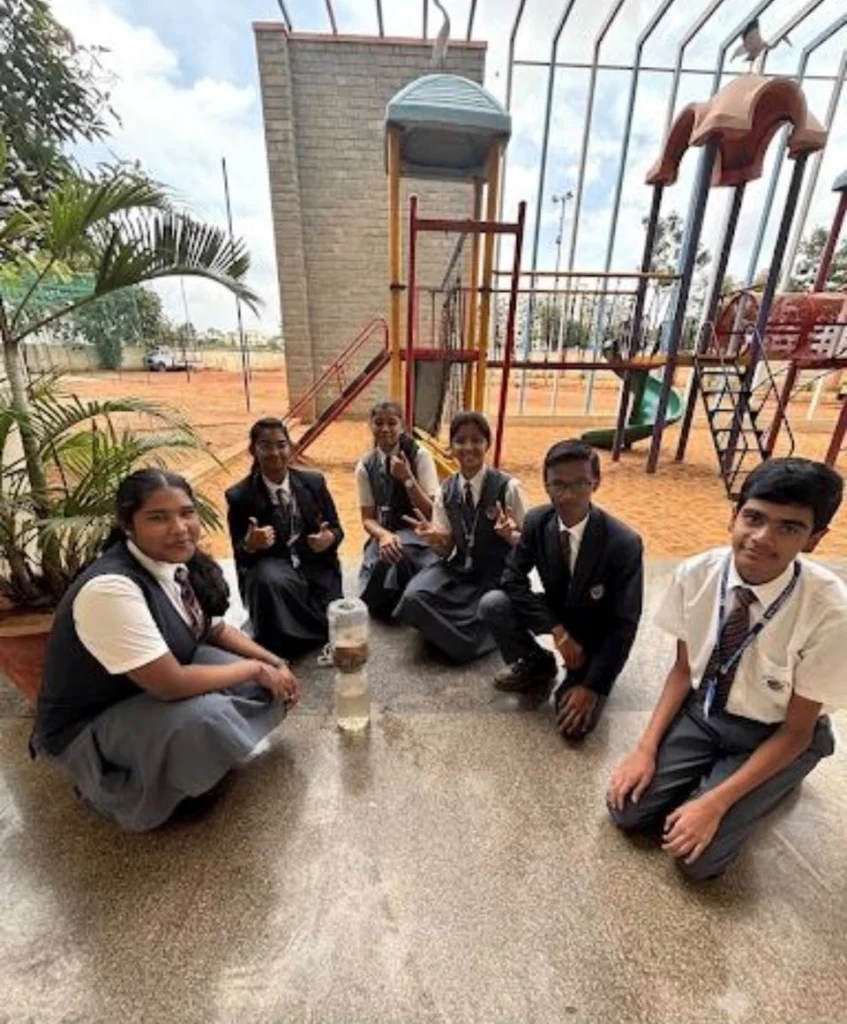
As part of the classroom activity, students designed and built a functional water filtration model using recycled plastic bottles, pebbles, gravel, and sand. They then filtered muddy water through the layers and carefully observed how each material removed impurities.
The activity demonstrated the importance of clean drinking water, sustainable resource management, and simple engineering principles used in natural water filtration systems.
What Happened During the Activity?
Working in groups, students first discussed the challenges of water pollution and the need for clean water. They then assembled their filtration models by carefully arranging different natural materials in layers.
After pouring muddy water into the filter, students observed the purification process step by step. Large stones trapped bigger debris, gravel filtered medium-sized particles, and fine sand removed smaller impurities, resulting in visibly cleaner water.
Throughout the activity, students recorded their observations, compared results, and discussed why each filtration layer played an important role. This practical demonstration helped transform theoretical knowledge into meaningful understanding.
What Did Students Learn?
• The activity enabled students to understand:
• The importance of clean and safe drinking water.
• How natural filtration systems remove impurities.
• The role of sustainable resource management.
• The significance of water conservation.
• Real-life applications of environmental science and engineering.
• How communities can use simple filtration methods where clean water is limited.
How Did This Activity Support Experiential Learning?
The DIY Water Filter Activity was much more than a classroom experiment.
Students actively participated in experiential learning by building and testing their own filtration models instead of only studying the concept theoretically. The activity also promoted hands-on learning, allowing them to apply classroom knowledge in a practical environment.
As students observed the filtration process, asked questions, analyzed results, and discussed improvements, they engaged in inquiry-based learning. By working together to solve a real-world environmental challenge, they also experienced project-based and collaborative learning, strengthening their teamwork, communication, critical thinking, and problem-solving abilities.
Student Learning Outcomes & Benefits
Students developed:
• Environmental awareness
• Critical thinking
• Scientific observation
• Teamwork
• Collaboration
• Communication skills
• Problem-solving abilities
• Analytical thinking
• Responsibility towards sustainable living
• Appreciation for water conservation
These competencies are essential for lifelong learning and align with the CBSE emphasis on competency-based education.
How Does This Activity Support CBSE Learning?
The CBSE curriculum encourages students to connect academic concepts with real-life situations.
This classroom activity enabled students to apply theoretical knowledge about water resources through observation, experimentation, teamwork, and reflection. Such learning experiences improve conceptual understanding while nurturing essential 21st-century skills.
Why Should Parents Value Such Activities?
Parents today seek schools that prepare children not only for examinations but also for life.
Activities like the DIY Water Filter project help students:
• Understand environmental responsibility.
• Develop confidence through practical learning.
• Improve collaborative and communication skills.
• Think critically about real-world challenges.
• Build curiosity through observation and experimentation.
These experiences contribute to the holistic development that modern CBSE education aims to achieve.
Learning Beyond the Classroom at BRS Global School Attibele
At BRS Global School | Pre-school, Primary School & High School | Attibele, classroom learning is enriched through practical experiences that make education engaging and meaningful.
Whether it is environmental awareness, science-based projects, leadership programmes, sports, arts, or life skills, students are encouraged to become active learners who explore, question, and innovate.
Families searching for schools in Attibele, CBSE schools in Attibele, schools in Chandapura, schools in Anekal, schools in Hosur, or schools near Sarjapur Road appreciate our balanced approach that combines academic excellence with experiential learning.
Parents looking for another BRS Global School campus closer to Kasavanahalli, Bellandur, HSR Layout, Carmelaram, Gunjur, Varthur, Kodathi, Harlur, Marathahalli, and Dommasandra can also explore our BRS Global School | Best CBSE School in Sarjapur Road, another branch of BRS Global School.
Common Parent Questions
Why do students perform classroom activities instead of only reading textbooks?
Practical activities improve understanding, retention, curiosity, and application of concepts. Students learn more effectively when they experience concepts through observation and experimentation.
How does experiential learning benefit Grade 10 students?
Experiential learning helps students develop critical thinking, problem-solving, teamwork, and confidence while strengthening conceptual clarity for higher education and everyday life.
Does this activity help in environmental education?
Yes. Students learn the importance of clean water, water conservation, sustainability, and responsible use of natural resources through practical experience.
Key Highlights
• Grade 10 Social Studies classroom activity
• DIY Water Filter using recycled materials
• Practical understanding of water purification
• Experiential and inquiry-based learning
• Project-based collaborative activity
• Environmental awareness and sustainability education
• CBSE competency-based learning
• Real-world application of classroom concepts
Frequently Asked Questions (FAQs)
What is the DIY Water Filter Activity?
It is a classroom activity where students create a simple filtration system using natural materials to understand how water purification works.
Which class participated in the activity?
Grade 10 students participated as part of their Social Studies lesson on Water Resources.
What materials were used?
Recycled plastic bottles, pebbles, gravel, sand, and muddy water.
What skills did students develop?
Critical thinking, collaboration, observation, communication, environmental awareness, and problem-solving.
Why is water purification important for students to learn?
It helps students understand sustainable resource management, environmental conservation, and the importance of access to clean water.
How does this activity support holistic development?
It combines academic knowledge with practical application, teamwork, creativity, environmental responsibility, and critical thinking.
Conclusion
The DIY Water Filter Activity gave Grade 10 students an engaging opportunity to explore water purification through experiential learning. By transforming classroom concepts into practical experiences, students gained a deeper appreciation for environmental sustainability and the importance of conserving water resources.
At BRS Global School | Pre-school, Primary School & High School | Attibele, we continue to provide meaningful learning experiences that nurture curiosity, innovation, and responsible citizenship while preparing students for future success.
Parents looking for a premium CBSE education that balances academics with experiential learning are invited to visit our Attibele campus and discover how our students learn beyond the classroom.